 Conflict
India-Pakistan armed conflict possible in 2026, US think tank flags ‘moderate risk’
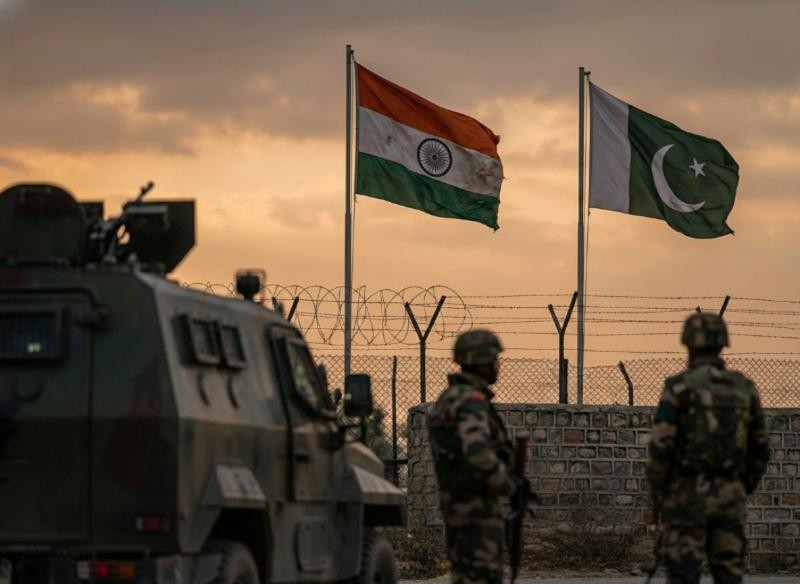
A renewed armed confrontation between India and Pakistan cannot be ruled out in 2026, a leading US think tank has warned, citing heightened terrorist activity and escalating military preparedness on both sides.
According to the Conflicts to Watch in 2026 report by the Council on Foreign Relations (CFR), disputes between New Delhi and Islamabad carry a “moderate likelihood” of turning into an armed conflict next year.
The report also assesses the potential fallout as having a “moderate impact” on American strategic interests.
The CFR notes that the risk stems primarily from the possibility of renewed terrorist attacks triggering military retaliation.
“There is a moderate likelihood of renewed armed conflict between India and Pakistan due to heightened terrorist activity,” the report stated.
The warning comes months after India and Pakistan were locked in a four-day military standoff in May, marked by drone strikes, missile launches and counter-attacks.
The escalation followed India’s launch of Operation Sindoor, a targeted military campaign aimed at dismantling terror infrastructure in Pakistan and Pakistan-Occupied Kashmir (PoK), after Pakistan-backed terrorists killed 22 civilians in Jammu and Kashmir’s Pahalgam.
Although Pakistan subsequently sought a ceasefire, tensions have remained simmering.
Pakistani leaders have issued provocative statements, while Indian intelligence assessments indicate the continued presence of more than 30 Pakistani terrorists operating in the Jammu region during the winter months, despite the absence of a major terror attack since the ceasefire.
Even as overt hostilities have paused, both nations have accelerated defence modernisation.
India’s Defence Acquisition Council recently cleared procurement proposals worth nearly Rs 79,000 crore, covering drones, air-to-air missiles and precision-guided munitions.
Pakistan, meanwhile, is reported to be in talks with Turkey and China to acquire drones and air defence systems to address vulnerabilities exposed during Operation Sindoor.
The CFR report also places the India-Pakistan situation within a broader global context.
It notes that the second Trump administration has actively sought to wind down or de-escalate multiple global conflicts, including those in Ukraine, Gaza, the Democratic Republic of Congo, and tensions involving India-Pakistan, as well as Cambodia-Thailand.
Beyond South Asia’s eastern flank, the report flags another potential flashpoint involving Pakistan.
It identifies a “moderate likelihood” of armed conflict between Afghanistan and Pakistan in 2026, though it assesses the potential impact on US interests as “low”.
The warning follows violent clashes earlier this year along the 2,600-kilometre Durand Line, where Pakistani and Taliban-led Afghan forces exchanged fire across at least seven locations.
Both sides accused each other of cross-border attacks, destruction of military posts, and harbouring militant groups, marking one of the most serious escalations in recent years.
The deterioration in security ties has since strained diplomatic and trade relations between Kabul and Islamabad.
Pakistan has borne the brunt of disrupted bilateral trade, while Afghanistan’s Taliban regime has sought to diversify its economic partnerships by expanding trade links with countries such as India, Iran and Turkey.
The Conflicts to Watch in 2026 report is designed to alert US policymakers to emerging global flashpoints.
It categorises conflicts into Tier 1, Tier 2 and Tier 3, based on their likelihood of escalation and potential impact on American interests, with each assessed as high, moderate or low.
Support Our Journalism
We cannot do without you.. your contribution supports unbiased journalism
IBNS is not driven by any ism- not wokeism, not racism, not skewed secularism, not hyper right-wing or left liberal ideals, nor by any hardline religious beliefs or hyper nationalism. We want to serve you good old objective news, as they are. We do not judge or preach. We let people decide for themselves. We only try to present factual and well-sourced news.
Support objective journalism for a small contribution.