NASA’s OSIRIS-REx captures new Earth-Moon image
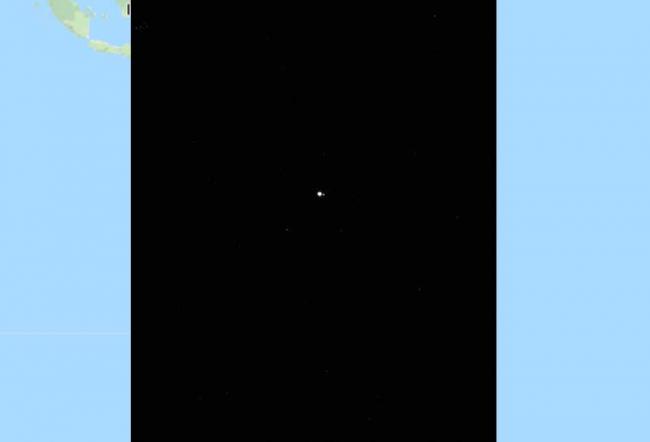
Washington, Feb 15 (IBNS): As part of an engineering test, NASA’s OSIRIS-REx spacecraft captured this image of the Earth and Moon using its NavCam1 imager on January 17 from a distance of 39.5 million miles (63.6 million km).
When the camera acquired the image, the spacecraft was moving away from home at a speed of 19,000 miles per hour (8.5 kilometers per second).
Earth is the largest, brightest spot in the center of the image, with the smaller, dimmer Moon appearing to the right.
Several constellations are also visible in the surrounding space.
The bright cluster of stars in the upper left corner is the Pleiades in the Taurus constellation.
Hamal, the brightest star in Aries, is located in the upper right corner of the image. The Earth-Moon system is centered in the middle of five stars comprising the head of Cetus the Whale.
NavCam1, a grayscale imager, is part of the TAGCAMS (Touch-And-Go Camera System) navigation camera suite.
Malin Space Science Systems designed, built, and tested TAGCAMS; Lockheed Martin integrated TAGCAMS to the OSIRIS-REx spacecraft and operates TAGCAMS.
Image Credit: NASA/Goddard/University of Arizona/Lockheed Martin
Support Our Journalism
We cannot do without you.. your contribution supports unbiased journalism
IBNS is not driven by any ism- not wokeism, not racism, not skewed secularism, not hyper right-wing or left liberal ideals, nor by any hardline religious beliefs or hyper nationalism. We want to serve you good old objective news, as they are. We do not judge or preach. We let people decide for themselves. We only try to present factual and well-sourced news.
Support objective journalism for a small contribution.