


 Sri Lanka
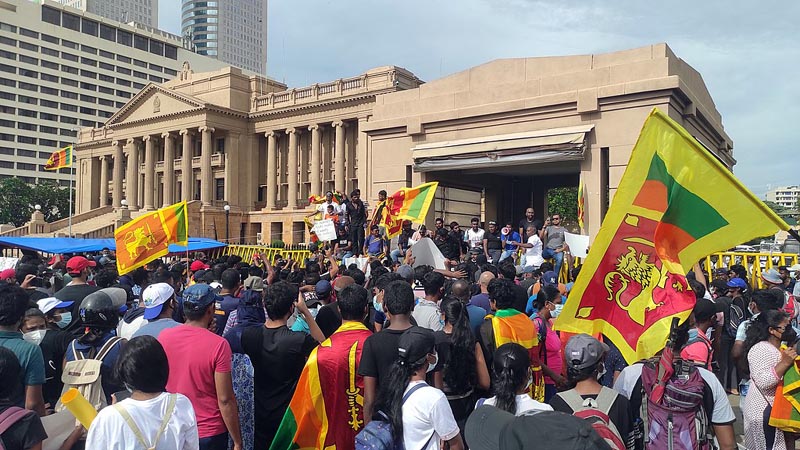
Sri Lanka's fuel crisis goes from bad to worse amidst president's decision to quit
Colombo: Fuel queues in Colombo, Sri Lanka's capital, and its suburbs have grown longer stretching as far as eight kilometres each.
The minimum waiting time for a vehicle to get fuel is four hours. This trend has been going on for the past four months and this spite the president and his cabinet resigning, it is unlikely to stop, economic analysts say.
Nandasena Fernando Raju (26), an electrician turned three-wheeler driver due to the acute economic crisis told United News of India that he shifted out of necessity from Kalutara to procure hires in Colombo and the suburbs.
Now on the 12th day in Colombo, he pretty much eats sleeps and puts his clothes to dry in the three-wheeler. “I brought a set of clothes and a pillow. I sleep on the three-wheeler and haven't seen my folks in 12 days.”
He said that four months ago he earned a very good income of rupees 150,000 a month and managed to live in his hometown in his ancestral home with his parents and had a job that he started at the age of 19 just after finishing school.
“I took housing contracts and formed my own company called FR Constructions. I had to give it up because not many people wanted to get their houses wired and due to the cost of equipment increasing exponentially,” he added that the stock of equipment needed for wiring which cost rupees 45,000 in February increased to rupees 96,000 by June.
"People didn't have the cash to spend on such expensive things," he added.
Raju noted that hiring a three-wheeler fetches him rupees 7500 a day and he has to set aside about rupees 2500 for petrol.
“But I am in the petrol queue for three to four days and it is really not worth it,” he added that he spends rupees 23,000 a month to finance the three-wheeler which earns him an income which is just adequate for survival only.
Raju added that the president and the cabinet resigning will not bring any immediate solution or relief, adding that it will at least take another three to four years to get the fuel and cooking gas situation right.
After a request from the General Treasury the Central Bank last week disclosed that it will provide liquidity to the value of Rs 217 billion to finance fuel imports by Ceylon Petroleum Corporation (CPC).
The banking regulator issued Rs 107 billion to CPC, last Friday. In a special issuance of Treasury bills to the Central Bank, the government had borrowed this money as CPC is still enduring an acute rupee liquidity crunch, on top of the dollar crunch, even after it raised the prices of petroleum products to extreme levels a couple of times, through what has now turned out to be a controversial pricing formula.
Since the end of June, the state-run CPC had been supplying fuel only for essential services, including power generation.
Sri Lanka spends around $100 million to import fuel needed to run its thermal power plants and the Ministry of Energy purchased 7,500 metric tonnes of diesel from Lanka Indian Oil Corporation (LIOC) a few days ago for $11 million to run essential services.
Central Bank Governor Dr Nandalal Weerasinghe stressed on the dislike the regulator faces when implementing monetary financing, telling reporters that it is not something neither they nor the Treasury likes to do but under the current context, are compelled to meet certain requests to meet their exigencies.
Until September last year, the Treasury bill auctions saw only a fraction of being subscribed by the market, due to the yield controls, and hence the balance had to be bought by the Central Bank through printed money, which also added to the exponential monetary expansion.
Support Our Journalism
We cannot do without you.. your contribution supports unbiased journalism
IBNS is not driven by any ism- not wokeism, not racism, not skewed secularism, not hyper right-wing or left liberal ideals, nor by any hardline religious beliefs or hyper nationalism. We want to serve you good old objective news, as they are. We do not judge or preach. We let people decide for themselves. We only try to present factual and well-sourced news.
Support objective journalism for a small contribution.



