


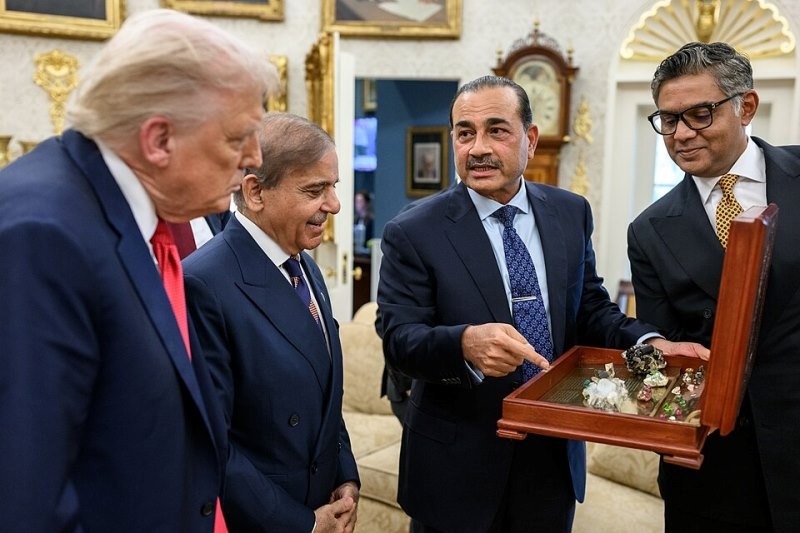
 Asim Munir
Asim Munir under pressure as Trump wants Pakistani troops in Gaza
Pakistan Army chief General Asim Munir is grappling with a crisis largely of his own making, as mounting pressure from Washington collides with volatile public sentiment at home.
The immediate flashpoint is a US-led push, backed by President Donald Trump, urging Pakistan to contribute troops to a proposed International Stabilisation Force in Gaza.
For Munir, the decision is fraught with political, religious and strategic consequences, highlighting how deeply Pakistan’s military leadership remains tied to external patrons even as domestic legitimacy erodes.
Another Washington visit, higher stakes
Munir is preparing for yet another visit to Washington—his third in under six months—to meet Trump, who has rolled out a 20-point Gaza stabilisation framework with United Nations backing.
The plan places the onus on Muslim-majority countries with significant military capacity to play a frontline role in Gaza’s post-war transition.
Pakistan, with its large and battle-hardened army and status as the world’s only Muslim nuclear power, has emerged as a key focus of US expectations.
Inside Trump’s Gaza stabilisation plan
The proposed International Stabilisation Force is envisioned as a multinational contingent drawn primarily from Muslim countries to oversee security, reconstruction and economic revival in Gaza following prolonged Israeli military operations.
According to reports, a two-star US general would command the force, with coordination centres already established in Israel, though Washington has stressed that American troops will not be deployed on the ground.
Discussions on the structure of the force took place recently in Qatar, with countries such as Pakistan, Egypt, Indonesia, Jordan, Qatar, the UAE and several Western nations invited.
Turkey, a vocal supporter of Hamas, was notably excluded.
While many Muslim states are wary of confronting Hamas directly, Pakistan stands out due to both its military capacity and geopolitical weight.
Pakistan’s long-standing hostility towards Israel
Islamabad has never recognised Israel and has historically framed itself as a steadfast supporter of the Palestinian cause.
This position dates back to Pakistan’s founding and remains embedded in state policy.
Pakistani passports still bar travel to Israel, and Israeli ties with India further reinforce Islamabad’s hostility.
Unlike several Arab states that joined the Abraham Accords, Pakistan has refused normalisation, insisting it can only follow the creation of a Palestinian state with East Jerusalem as its capital.
Over time, this stance has hardened into political orthodoxy.
The Gaza war that erupted in October 2023 has intensified emotions further.
Pakistani leaders have accused Israel of genocide and war crimes, rhetoric that resonates strongly with Islamist groups, clerics and street movements capable of rapid mobilisation.
Why Munir has little room to move
Since assuming office, Munir has cultivated an image as a devout Muslim and protector of Islamic values.
Deploying Pakistani troops to Gaza under a US-designed framework that ultimately safeguards Israeli security would puncture that carefully crafted persona.
Domestically, such a move risks being portrayed as Pakistan’s army serving Israeli interests—an accusation that could ignite protests, especially amid lingering anger over the imprisonment of former prime minister Imran Khan.
Islamist groups, despite bans and arrests, continue to wield ideological and street influence.
There is also the risk of diplomatic fallout with countries such as Turkey and Qatar, which maintain more sympathetic positions towards Hamas.
Experts warn of political blowback
Analysts say Munir’s dilemma is acute.
Michael Kugelman of the Atlantic Council notes that refusing Washington could irritate Trump, a dangerous prospect for a Pakistan desperate for US investment, military aid and diplomatic cover.
At the same time, defence analyst Ayesha Siddiqa argues that Pakistan’s military strength itself increases pressure on Munir to “deliver capacity” when called upon.
Singapore-based analyst Abdul Basit has warned that once deployed, any escalation of violence would swiftly turn public anger against the army chief, reinforcing perceptions that he is acting at Israel’s behest.
Even Foreign Minister Ishaq Dar has attempted to hedge, suggesting Pakistan might consider peacekeeping roles while stressing that disarming Hamas is “not our job,” a formulation that reflects Islamabad’s increasingly untenable balancing act.
The Trump–Munir dynamic
Despite domestic risks, Munir appears reluctant to defy Washington.
He has invested heavily in rebuilding ties with Trump, culminating in a rare White House lunch that excluded Pakistan’s civilian leadership.
That warmth has unsettled India, particularly after Washington approved a $686 million F-16 sustainment package for Pakistan.
Observers see Trump’s engagement with Munir as emblematic of a transactional US approach that prioritises short-term utility over accountability, despite Pakistan’s troubled record on terrorism and regional stability.
Munir’s personal authority has also expanded dramatically.
He now commands all three armed services, has secured an extension until 2030, and enjoys constitutional protections granting lifetime immunity from prosecution.
Analysts argue this concentration of power reduces internal constraints on his decision-making.
A familiar civil-military pattern
Pakistan’s military has long sought external validation and resources, often at the expense of domestic cohesion.
Munir’s Gaza predicament follows that pattern. His recent flurry of meetings with leaders from Saudi Arabia, Turkey, Jordan, Egypt and Southeast Asia is widely seen as consultation over the Gaza force.
Yet the outcome remains bleak.
Agreeing to send troops risks domestic unrest and exposes Pakistan’s dependency on Washington.
Refusing risks alienating Trump at a time when Islamabad needs US backing more than ever.
For Asim Munir, Gaza has become more than a foreign policy challenge.
It is a reflection of the contradictions at the heart of Pakistan’s military-dominated state—one that seeks Islamic legitimacy at home while striking transactional deals abroad.
Support Our Journalism
We cannot do without you.. your contribution supports unbiased journalism
IBNS is not driven by any ism- not wokeism, not racism, not skewed secularism, not hyper right-wing or left liberal ideals, nor by any hardline religious beliefs or hyper nationalism. We want to serve you good old objective news, as they are. We do not judge or preach. We let people decide for themselves. We only try to present factual and well-sourced news.
Support objective journalism for a small contribution.


