 Shashi Tharoor
'A travesty of justice': Shashi Tharoor questions Umar Khalid's six-year jail term without trial
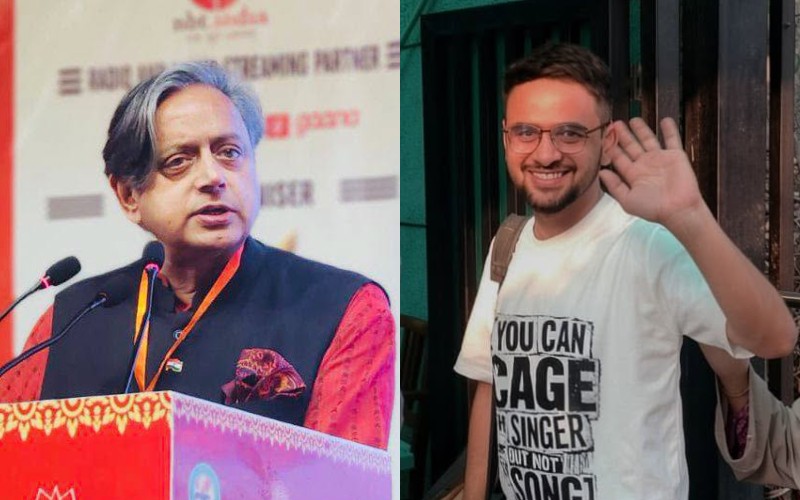
New Delhi/IBNS: Congress MP Shashi Tharoor has questioned the continued incarceration of former Jawaharlal Nehru University (JNU) student leader Umar Khalid, asking why the allegations against him have not yet been tested in court despite nearly six years in prison.
Tharoor described the prolonged detention without trial as "a travesty of justice and a blot on our democracy", reigniting debate over one of the country's most closely watched legal cases.
His remarks came after the British newspaper The Guardian published Khalid's first interview since his arrest in 2020 in connection with the larger conspiracy case linked to the 2020 Delhi riots.
Tharoor questions delay in trial
Sharing The Guardian interview on X, Tharoor asked why the prosecution had not yet established its case in court if the allegations against Khalid were credible.
"This moving article on [Umar Khalid] in prison prompts a simple question: if he really has incited terrorism, why not prove it in a court of law?" Tharoor wrote.
He further added, "Why deny him the basic right of any Indian citizen accused of a crime, the right to a fair trial? Languishing six years behind bars, without a chance to defend himself legally, is a travesty of justice and a blot on our democracy. I think the people of India have a right to know why."
This moving article on @UmarKhalidJNU in prison prompts a simple question: if he really has incited terrorism, why not prove it in a court of law? Why deny him the basic right of any Indian citizen accused of a crime, the right to a fair trial? Languishing six years behind bars,…
— Shashi Tharoor (@ShashiTharoor) June 30, 2026
The Congress MP's comments followed the publication of Khalid's interview, in which the former student leader reflected on his years in prison and criticised what he described as the silence of sections of the political opposition.
Umar Khalid breaks silence
In the interview with The Guardian, Khalid said he felt increasingly isolated after spending years in Delhi's Tihar Jail while awaiting trial.
"Six years down the line, I must say that I am really disappointed and even feel isolated. This silence – of opposition parties, of civil society groups, of celebrity activists who have made a career out of piggy-backing on people's movements – emboldens this regime to go after further dissidents," he said.
Khalid also spoke about the personal impact of prolonged incarceration.
"When you are reduced to just an image, either negative or positive, it becomes difficult to maintain not just your humanity but even your sanity at times," he said.
He added that fellow inmates sometimes referred to him as a terrorist, saying, "You even hear murmurs about yourself from fellow prisoners you shared meals with, calling you a terrorist behind your back. This propaganda dehumanises me in people's eyes. Humanity is a privilege that is not granted to people like me."
Khalid also claimed that his political beliefs had remained unchanged during his imprisonment.
Referring to the country's political climate, he told The Guardian that "the process of India becoming a post-truth society is near complete" and criticised what he described as the "normalisation and glorification of hate speech and genocidal language".
Background of the Delhi riots case
Umar Khalid, who holds a PhD in History from Jawaharlal Nehru University, emerged as one of the prominent faces of protests against the Citizenship (Amendment) Act (CAA) in 2019.
During those demonstrations, he frequently advocated non-violent protest. One of his widely quoted statements was: "We won't respond to violence with violence. We won't respond to hate with hate. If they spread hate, we will respond to it with love."
In February 2020, communal violence erupted in northeast Delhi, leaving more than 50 people dead.
Seven months later, Delhi Police arrested Khalid, alleging that he was a key conspirator behind the violence and part of a broader conspiracy aimed at triggering unrest and engineering a violent regime change.
He was booked under the Unlawful Activities (Prevention) Act (UAPA).
Khalid has consistently denied all allegations, maintaining that the case against him is politically motivated.
The Bharatiya Janata Party (BJP) has repeatedly stated that India's judicial process functions independently and that the prosecution is not influenced by politics.
Latest legal developments
Khalid's bail applications have been heard on several occasions over the past few years but have repeatedly been adjourned, delayed or rejected.
Some hearings were also affected after judges recused themselves from the case.
Earlier this month, the Delhi High Court granted Khalid three days of interim bail from June 1 to June 3 to enable him to care for his mother following surgery.
The temporary relief came after a trial court declined his request for 15 days' bail to attend his maternal uncle's Chehlum (memorial) ceremony and assist his mother during her recovery.
Separately, Khalid has filed a fresh regular bail application.
A Delhi court has issued notice to Delhi Police and is scheduled to hear arguments on July 4.
In his latest plea, Khalid has cited changed circumstances, relying on a recent Supreme Court judgment that reiterated prolonged incarceration and delays in trial could outweigh the statutory restrictions on bail under the UAPA in appropriate cases.
The Supreme Court also expressed reservations about earlier reasoning adopted in bail matters involving accused persons under the UAPA, observing that courts must properly apply established legal principles concerning prolonged detention before trial.
Support Our Journalism
We cannot do without you.. your contribution supports unbiased journalism
IBNS is not driven by any ism- not wokeism, not racism, not skewed secularism, not hyper right-wing or left liberal ideals, nor by any hardline religious beliefs or hyper nationalism. We want to serve you good old objective news, as they are. We do not judge or preach. We let people decide for themselves. We only try to present factual and well-sourced news.
Support objective journalism for a small contribution.