 Exam Reform
Why a rocket scientist, Aadhaar architect and IIT director are rebuilding India’s exam system
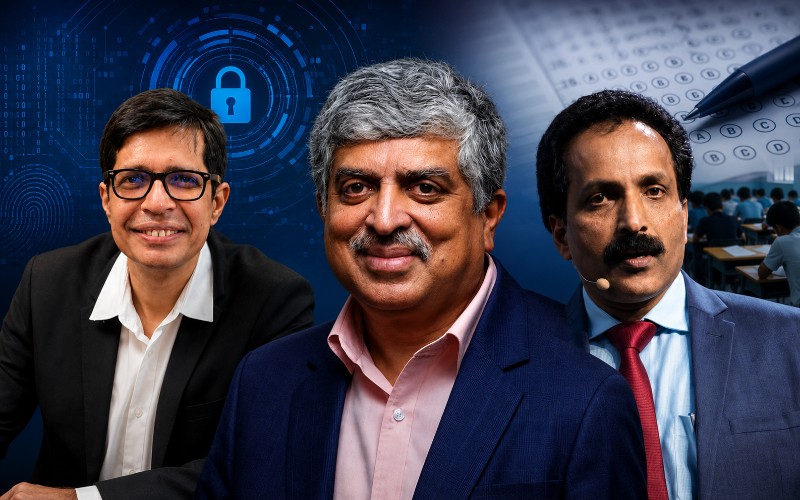
A rocket scientist, the architect of Aadhaar and the director of an IIT may appear to have little in common with examination administration. Yet their selection for a task force set up to overhaul India’s examination system reveals how dramatically the government is now viewing the problem.
The panel put together by Prime Minister Narendra Modi brings expertise from technology, space science, cybersecurity, intelligence, education, public administration and logistics into one reform effort.
Its composition indicates that paper leaks and examination failures are no longer being treated simply as isolated education-sector scandals.
Instead, the government appears to be approaching the examination system as a complex national infrastructure challenge, where technology, security, governance, logistics and operational reliability have to work together.
The approach comes after years of concerns surrounding paper leaks, technical glitches, administrative lapses and allegations of malpractice affecting competitive examinations.
Rather than addressing individual failures separately, the task force has been designed to examine vulnerabilities across the entire examination chain.
Nandan Nilekani and the digital trust challenge
The appointment of Nandan Nilekani is perhaps the strongest indication of the technological direction of the exercise.
Nilekani, the architect of Aadhaar, has spent years working on authentication, scalability, data integrity and digital infrastructure at a national level.
Those capabilities are increasingly relevant to an examination ecosystem that must authenticate millions of candidates, protect sensitive information and ensure that results are processed accurately and transparently.
His experience extends beyond Aadhaar.
From his association with the Unique Identification Authority of India (UIDAI) to his contribution to India’s wider digital public infrastructure ecosystem, Nilekani has been involved in building large-scale digital platforms designed to function across a vast and diverse population.
That experience could prove relevant to an examination system handling millions of candidates and requiring secure identification, reliable data management and transparent processes.
His inclusion points towards an approach that goes beyond tighter policing after a paper leak has already occurred.
The emphasis is instead on redesigning the architecture of examinations so that vulnerabilities can be identified and addressed before they develop into larger failures.
S Somanath brings space-mission precision
Former ISRO chairman S Somanath represents another critical element of the government’s approach: operational reliability.
Space missions are built around precision, planning and coordination, with thousands of interconnected components having to perform as intended.
A failure in one critical system can compromise years of work.
During his tenure at ISRO, Somanath was associated with complex technology programmes that demanded detailed planning, risk assessment and coordination between multiple teams and agencies.
Those same principles are relevant to examinations conducted simultaneously across a country as large as India.
Millions of candidates, thousands of examination centres, large numbers of personnel and tightly synchronised logistics have to be coordinated within narrow timeframes.
Somanath’s presence suggests that the government is looking towards organisations accustomed to executing large and technically complex national missions with high levels of operational discipline.
It also reflects a broader shift in the way examination administration is being conceptualised: not simply as a bureaucratic exercise, but as a systems and engineering challenge where reliability has to be designed into every stage.
V Kamakoti and the question of assessment
Securing examination papers and examination centres, however, is only one part of restoring confidence.
The assessment process itself also has to be transparent and accountable.
That is where IIT Madras Director V Kamakoti’s expertise becomes important.
A computer scientist whose work includes computer architecture, artificial intelligence and cybersecurity, Kamakoti also brings extensive experience in engineering education and academic administration.
His likely role extends beyond preventing leaks.
The broader question is how examinations are designed, conducted, evaluated and ultimately translated into results.
Earlier this year, the Union Education Ministry had tasked experts from IIT Madras with examining glitches in the Central Board of Secondary Education’s On-Screen Marking (OSM) portal and recommending measures to make the system more robust.
Kamakoti has also spoken about the importance of transparency in the use of technology in examinations.
“If a student secures 90 marks, then NTA must say how this was calculated. This is where technology is needed,” he said, stressing that students should have greater clarity about evaluation and result processing.
He has also emphasised that technology alone cannot guarantee a reliable examination system.
Responsibilities need to be clearly defined across the chain, from question paper setters and examination administrators to evaluators and those involved in processing results.
That approach places transparency for students and accountability within institutions at the centre of examination reform.
Intelligence expertise to counter organised cheating
The nature of examination malpractice has also changed.
The problem is no longer limited to traditional forms of cheating inside examination halls.
Modern examination fraud can involve organised networks, encrypted communications, impersonation and operations extending across state borders.
The inclusion of Intelligence Bureau Director Tapan Deka reflects that changing threat landscape.
Deka’s presence indicates that the government is looking at paper leaks and organised cheating not merely as isolated incidents but as security challenges that can require intelligence gathering, threat assessment and preventive action.
The involvement of an intelligence professional could strengthen the focus on organised networks operating around examinations, alongside technological safeguards designed to protect question papers, candidate information and examination processes.
Anita Karwal brings education governance into focus
Technology and security measures cannot function independently of the education system in which examinations operate.
Former Education Secretary Anita Karwal brings extensive experience in school education, examination administration and policy implementation to the task force.
Her involvement is significant because any technological or structural reform ultimately has to operate within the broader education framework.
The examination system involves students, schools, universities, examination bodies, administrators and evaluators, making institutional coordination essential to any major change.
Karwal’s experience could help connect proposed technological interventions with the administrative and policy structures that govern examinations.
Amrit Lal Meena and the logistics of a national exam
India’s examination system is also a vast logistical operation.
Question papers have to be transported securely, examination centres prepared, personnel deployed and materials delivered across multiple states.
Contingency arrangements must also be available when millions of candidates are scheduled to sit examinations at the same time.
Amrit Lal Meena, a senior bureaucrat with experience in large-scale infrastructure and administrative assignments, brings expertise relevant to this operational side of the system.
His inclusion highlights an often overlooked reality: an examination can fail even when its technology is secure if planning, coordination or execution breaks down.
Improving coordination between different agencies, centres and personnel is therefore another part of the task force’s wider mandate.
Six experts, six different vulnerabilities
The composition of the panel offers a window into the government’s understanding of the examination crisis.
Nilekani brings expertise in technology and digital public infrastructure, potentially helping develop secure and scalable examination systems.
Somanath brings systems engineering and experience in executing complex, mission-critical operations.
Deka contributes intelligence and national security expertise relevant to organised cheating networks and security threats.
Kamakoti combines engineering education with artificial intelligence and cybersecurity expertise, while Karwal brings education policy and examination governance experience.
Meena adds public administration, infrastructure and logistical expertise to the exercise.
Together, the appointments cover several points of vulnerability within the examination ecosystem.
The approach suggests that the government sees the crisis as extending well beyond paper leaks.
Technology, security, administration, logistics, governance and assessment are all interconnected, and weaknesses in one area can undermine the credibility of the entire system.
Reform goes beyond NTA
The task force’s proposed mandate is broader than simply preventing question papers from being leaked or fixing problems within the National Testing Agency (NTA).
Its recommendations are expected to examine technological, structural and institutional reforms across the examination ecosystem, covering the process from question paper creation and secure distribution to candidate authentication, evaluation, results and accountability.
The move also comes amid a leadership change at the Union Ministry of Education.
Following the resignation of Education Minister Dharmendra Pradhan, the government appointed Pralhad Joshi as the new Education Minister to oversee the implementation of the proposed reforms.
The wider reform exercise is taking place at a time when the Centre is seeking to strengthen confidence in the country’s examination architecture.
The selection of experts from technology, space science, intelligence, education and administration provides a clear indication of the scale of the exercise.
Support Our Journalism
We cannot do without you.. your contribution supports unbiased journalism
IBNS is not driven by any ism- not wokeism, not racism, not skewed secularism, not hyper right-wing or left liberal ideals, nor by any hardline religious beliefs or hyper nationalism. We want to serve you good old objective news, as they are. We do not judge or preach. We let people decide for themselves. We only try to present factual and well-sourced news.
Support objective journalism for a small contribution.