April 06, 2026 11:51 am (IST)

Follow us:


 Mali
Mali
Bamako under siege: Al-Qaida-linked JNIM pushes Mali—and West Africa—toward a security breaking point
An unprecedented crisis is unfolding in Mali as the capital, Bamako, finds itself encircled by Jama’at Nusrat al-Islam wal-Muslimin (JNIM), an al-Qaida-aligned militant coalition.
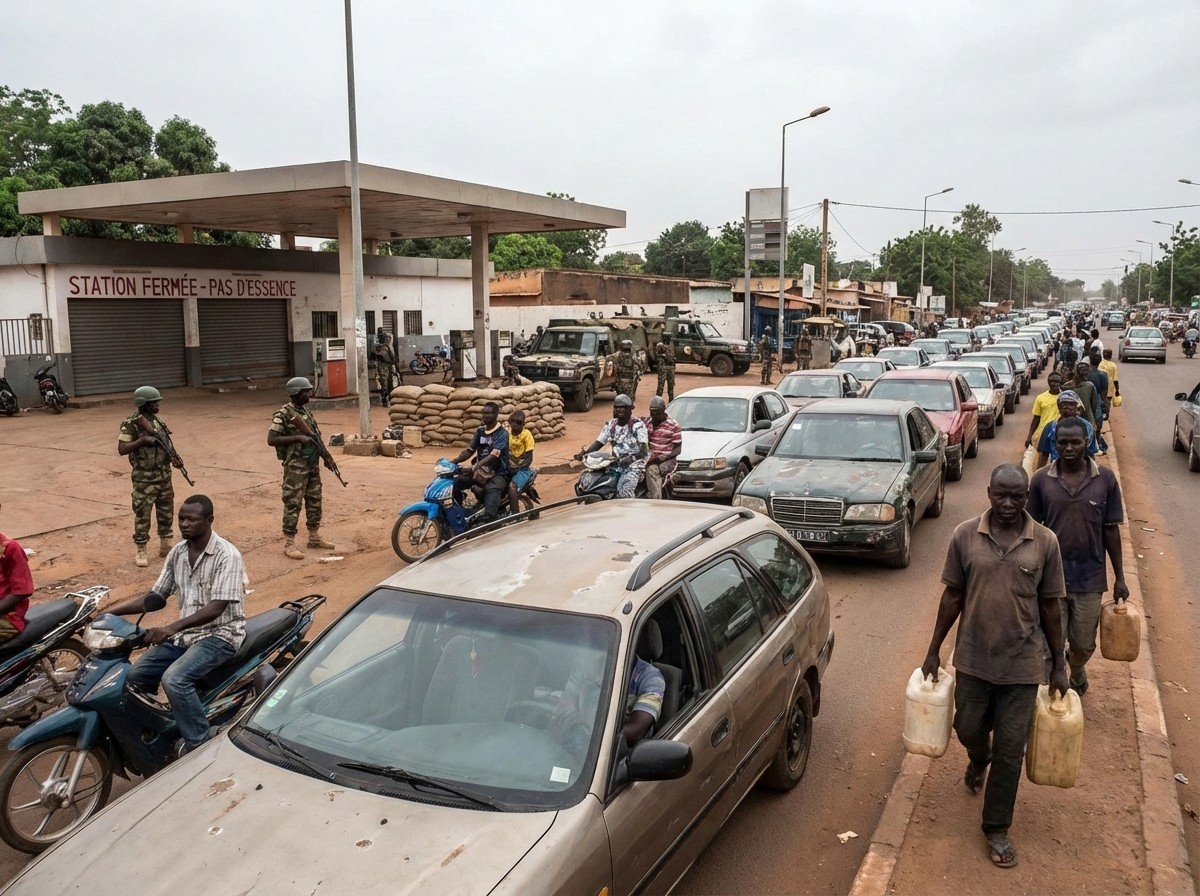
Long regarded as a refuge from the Sahel’s grinding insurgency, the city is now grappling with fuel shortages, shuttered schools, and a breakdown of essential services.
What began as a rural jihadist campaign has evolved into a calculated urban pressure strategy, raising alarms far beyond Mali’s borders.
Security analysts say the blockade marks a decisive escalation.
Security analysts say the blockade marks a decisive escalation.
By choking fuel and trade routes linking Bamako to Senegal and Côte d’Ivoire, JNIM has struck at the state’s economic and political core.
The tactic reflects an ambition not merely to harass the government but to paralyse it, exposing the fragility of Mali’s governing structures under military rule.
From coup promises to deepening insecurity
Mali’s current predicament can be traced back to the 2020 coup, when the military seized power pledging to restore order after years of violence.
Instead, insecurity has intensified. Conflict monitoring data shows a sharp rise in attacks and fatalities since the junta took control, with JNIM responsible for the overwhelming majority of incidents.
The military government’s pivot away from Western partners and its embrace of Russian mercenaries have failed to reverse the trend.
The withdrawal from multinational security frameworks and the expulsion of UN peacekeepers have left Mali increasingly isolated, overstretching its armed forces as they attempt to defend shrinking territory while escorting vital supply convoys into a besieged capital.
Blockade warfare and a growing polycrisis
The siege of Bamako underscores a shift in jihadist warfare across the Sahel. Instead of hit-and-run assaults on remote outposts, JNIM is targeting economic lifelines.
Fuel shortages have driven prices higher, disrupted healthcare and food distribution, and forced universities to shut down.
Each government response has produced new vulnerabilities, diverting troops from rural areas and allowing militants to expand elsewhere.
This convergence of security, economic and humanitarian crises has created what observers describe as a self-reinforcing polycrisis.
This convergence of security, economic and humanitarian crises has created what observers describe as a self-reinforcing polycrisis.
As livelihoods collapse, recruitment pools for extremist groups widen, deepening the cycle of instability.
A networked insurgency with global reach
JNIM’s offensive reflects the evolution of a decentralised but coordinated insurgency.
While rooted in local grievances, the group operates within al-Qaida’s global ecosystem.
Intelligence assessments suggest that foreign fighters displaced from Middle Eastern conflict zones have strengthened Sahelian jihadist ranks, bringing battlefield experience and transnational financing networks.
This hybrid structure has allowed JNIM to conduct simultaneous operations across Mali, Niger and Burkina Faso, while probing new fronts closer to coastal West Africa.
This hybrid structure has allowed JNIM to conduct simultaneous operations across Mali, Niger and Burkina Faso, while probing new fronts closer to coastal West Africa.
Analysts warn that the tactics used around Bamako could soon be replicated against other regional capitals.
Humanitarian fallout and eroding legitimacy
Beyond strategy and geopolitics lies a mounting human toll. Thousands have fled violence near Mali’s borders, seeking refuge in neighbouring Mauritania.
Villages have been emptied under threat, while civilians face violence from both militant groups and counterterror operations. Displacement figures continue to climb, further straining humanitarian systems.
As hardship grows, public confidence in the junta is eroding. For many civilians, the state no longer represents security but exposure to danger.
Analysts note that this erosion of legitimacy aligns with JNIM’s broader objective: weakening the social contract between citizens and the state.
Regional isolation and strategic vacuum
Mali’s withdrawal from regional blocs and security partnerships has compounded its vulnerability.
Plans for a regional counterterrorism force have faltered amid political rifts, leaving a vacuum that jihadist groups are exploiting.
While new alliances among Sahelian military regimes were intended to bolster collective defence, each member remains overwhelmed by internal insurgencies.
The result is a fragmented security landscape, where coordination is scarce and militant networks operate with increasing freedom.
The result is a fragmented security landscape, where coordination is scarce and militant networks operate with increasing freedom.
A crisis with regional and global stakes
The siege of Bamako is no longer just Mali’s problem.
As jihadist influence consolidates in the Sahel, strategic corridors toward coastal states are opening, raising risks for countries already reporting northern incursions.
For Europe and other external stakeholders, further destabilisation threatens migration routes, trade flows and counterterrorism efforts.
With the Sahel emerging as a central theatre of global jihad, the stakes extend well beyond West Africa.
With the Sahel emerging as a central theatre of global jihad, the stakes extend well beyond West Africa.
Bamako’s encirclement stands as a stark warning: unless regional and international actors adapt to this new phase of insurgency, the crisis risks reshaping the security order of an entire region.
#Bamako siege
# JNIM
# Mali security crisis
# al-Qaida Sahel
# West Africa terrorism
# jihadist insurgency
# Mali junta
# Sahel instability
Support Our Journalism
We cannot do without you.. your contribution supports unbiased journalism
IBNS is not driven by any ism- not wokeism, not racism, not skewed secularism, not hyper right-wing or left liberal ideals, nor by any hardline religious beliefs or hyper nationalism. We want to serve you good old objective news, as they are. We do not judge or preach. We let people decide for themselves. We only try to present factual and well-sourced news.
Support objective journalism for a small contribution.



Latest Headlines
Trump sets shock 'Tuesday, 8 pm' deadline for Iran over Strait of Hormuz—War warning escalates
Mon, Apr 06 2026
‘Gates of hell will open’: Iran mocks Trump’s 48-hour ultimatum, warns of devastating retaliation
Sun, Apr 05 2026
Inside the daring US mission to rescue downed airman in Iran amid race against time
Sun, Apr 05 2026