Economic Survey
Economic Survey calls for enhanced deregulation for MSMEs
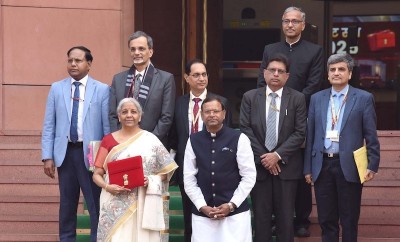
The Economic Survey, tabled by Union Minister of Finance and Corporate Affairs Nirmala Sitharaman, says that by reducing excessive regulatory burdens, governments can help businesses become more efficient, reduce costs, and unlock new growth opportunities.
Regulations increase the cost of all operational decisions in firms, the Economic Survey adds.
Recognising that the government has implemented several policies and initiatives over the last decade to support and promote the growth of MSMEs, the Survey says some challenges in the regulatory environment remain.
It says regulatory compliance burden holds back formalisation and labour productivity, limits employment growth, chokes innovation and depresses growth.
The Survey observes tendency for firms in India to remain small and the logic for it often is to remain under the regulatory radar and steer clear of the rules and labour and safety laws.
It says that the biggest casualties of this are employment generation and labour welfare, which most regulations were originally designed to encourage and protect, respectively.
The survey adds that the Union Government has undertaken deregulation by implementing process and governance reforms, simplifying taxation laws, rationalising labour regulations, and decriminalising business laws.
“On their part, states have also participated in deregulation by reducing compliance burdens and simplifying and digitising processes,” said the Survey. The assessment of states as per the Business Reform Action Plan (BRAP) formulated by DPIIT shows that deregulation helps spur industrialization.
Stating that such efforts have laid the foundation for states to embark on the next round of reforms now, the Economic Survey 2024-25 has outlined a three-step process for states to systematically review regulations for their cost-effectiveness.
The steps include identifying areas for deregulation, thoughtfully comparing the regulations with other states and countries and estimating the cost of each of these regulations on individual enterprises.
The survey highlights that Ease of Doing Business (EoDB) 2.0 should be a state government-led initiative focused on fixing the root causes behind the unease of doing business. It mentions that in the next phase for EoDB, states must break new ground on liberalising standards and controls, setting legal safeguards for enforcement, reducing tariffs and fees, and applying risk-based regulation.
Citing examples from other countries, the survey mentions, “The need to find growth avenues in an export-challenged, environment challenged, energy-challenged, and emissions-challenged world means we need to act on deregulation with a greater sense of urgency. Without deregulation, other policy initiatives will not deliver on their desired goals."
"By empowering small businesses, enhancing economic freedom, and ensuring a level playing field, governments can help create an environment where growth and innovation are not only possible but inevitable. India's growth aspirations require nothing less," the survey said.
Support Our Journalism
We cannot do without you.. your contribution supports unbiased journalism
IBNS is not driven by any ism- not wokeism, not racism, not skewed secularism, not hyper right-wing or left liberal ideals, nor by any hardline religious beliefs or hyper nationalism. We want to serve you good old objective news, as they are. We do not judge or preach. We let people decide for themselves. We only try to present factual and well-sourced news.
Support objective journalism for a small contribution.