 UrbanPlanning
IIT Kharagpur and NIUA join hands to develop framework for universal city planning
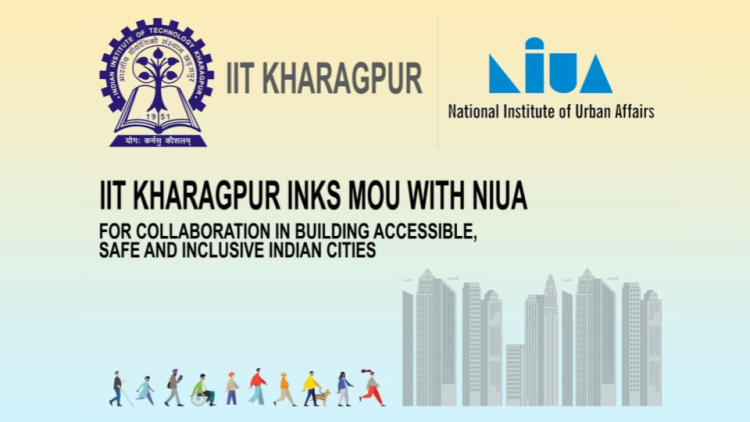
Kharagpur (WB)/IBNS: Premier educational institution IIT Kharagpur has signed a memorandum of understanding (MoU) with the National Institute of Urban Affairs (NIUA) for ‘Building Accessible Safe and Inclusive Indian Cities (BASIIC).
The collaboration is aimed towards developing a framework for universal city planning which would be more accessible and inclusive for various sections of the community with age-friendly disabled-friendly measures.
Director, Prof. Virendra K Tewari said, “India is a young country with a population growth rate of 1 per cent as of 2019. Such a growth figure along with the current status will create a dynamic need for housing and urban planning in India.”
According to Prof Tewari, “The Department of Architecture and Regional Planning at IIT Kharagpur is considered the best school in the country in the domain of architecture as per NIRF. We are proud to collaborate with NIUA in fulfilling its mission statement and achieving the comprehensive goals towards building sustainable living conditions for all.”
Through the Urban & Regional Development Plan Formulation and Implementation Guidelines, NIUA is dwelling upon new emerging aspects like regional development, inclusive planning, sustainable habitat, land use and transport integration at the planning stage, Service Level Benchmarks, disaster management concepts, and governance reforms.
But, there is a lack of consideration for universal design principles, it was noted.
Said Prof. Subrata Chattopadhyay from the Dept. of Architecture and Regional Planning at IIT Kharagpur, “After a thorough review of the various acts, guidelines and design standards in the related field and studying global best practices and international standard, IIT Kharagpur will propose a framework for universal cities to ensure that everyone, including people with disabilities, the elderly and parents with children, can participate in society and access built environment, transport, services and urban amenities including recreation and also livelihood and information.”
He also stressed the need for seamless accessibility and the complete travel chain for safe and independent movement for all within the city.
The proposed framework will be instrumental for sector-wise assessment of the existing cities in terms of safety, accessibility and inclusivity as well as planning of Greenfield cities.
The framework will include sections on Infrastructure, amenities and services including water, electricity, sanitation and solid waste; Outdoor environment; Livelihood; Urban mobility and public transport; IT connectivity, digitalization and citizen’s participation, and Tourism and recreation.
Prof. Haimanti Banerji from the Dept. of Architecture and Regional Planning at IIT Kharagpur, said, “Differently abled persons and elderly often face discrimination and segregation due to the presence of sensory, attitudinal, cognitive, physical, and economic barriers. Through this framework, we would aim to crystallize future pathways for the planning of accessible, safe and inclusive cities in India, by laying emphasis on the process of audit, ground-level data collection, analysis, planning and implementation that would lead to sustainable and user-centric outcomes.”
The researchers are further working on several such developmental projects encompassing affordable housing, innovative construction technologies, dignified living and productive participation for the trans-generational population, the IIT said in a release.
Support Our Journalism
We cannot do without you.. your contribution supports unbiased journalism
IBNS is not driven by any ism- not wokeism, not racism, not skewed secularism, not hyper right-wing or left liberal ideals, nor by any hardline religious beliefs or hyper nationalism. We want to serve you good old objective news, as they are. We do not judge or preach. We let people decide for themselves. We only try to present factual and well-sourced news.
Support objective journalism for a small contribution.