Innovation is key to realise Digital India vision says minister
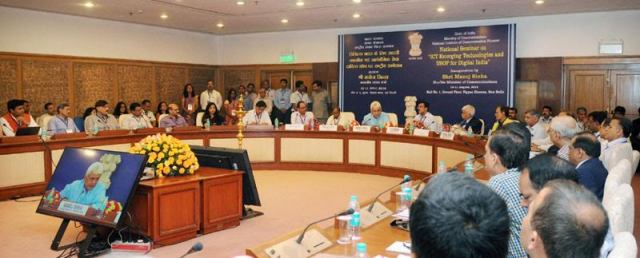
Inaugurating a seminar, on Wednesday,organised by National Institute of Communication Finance on 'ICT emerging technologies & USOF for Digital India', the Minister said there is need for innovation in this sector as India cannot afford to emulate the developed economies due to limited resources.
He said, if India lags in catching up with emerging technologies in the coming 15 to 20 years, the very existence of the country will be at stake.
The minister expressed the hope that by March, 2017, one lakh Gram Panchayats (GPs) will be connected through Optical Fibre Cable (OFC) to set up a network infrastructure to serve the rural masses. He said, whether network infrastructure or digital highway, there is need for finding appropriate technologies for the deprived sections of society.
Speaking on the occasion, Secretary Telecom J.S.Deepak said that Finance Ministry is very conservative in allocation of funds under Universal Service Obligation Fund (USOF). He said despite Rs 70,000 crore available under USOF, allocation of work is less than 40 per cent. He, however, admitted that the execution of digital infrastructure projects particularly in rural areas needs to be speeded up.
He also announced that Rs 10,000 crore will be spent in 2016-17, which is the highest in the history of USOF.
In his address, Chairman, TRAI, R.S.Sharma said that for transforming India into Digitally Empowered Society and Knowledge Economy, public-private partnership is definitely the best mode. He said, when mobile telephony made its foray into India, there were two crore fixed telephone lines and the number remains the same even today even though the mobile subscribers have crossed 100 crore mark. He also cautioned that the era of voice has been replaced by data and if India lags behind in building the Digital Highway in a time bound manner, there will be problems of traffic jam.
The two-day long seminar will deliberate on topics like changing role of USOF, regulatory issues and its future perspective, challenges of consolidation in digital Indian initiatives, Bharat Net and road ahead, broadband proliferation by telecom service providers, unlicensed spectrum for Wi-Fi etc.
Image: At the ICT Emerging Technologies & USOF for Digital India meet/PIB
Support Our Journalism
We cannot do without you.. your contribution supports unbiased journalism
IBNS is not driven by any ism- not wokeism, not racism, not skewed secularism, not hyper right-wing or left liberal ideals, nor by any hardline religious beliefs or hyper nationalism. We want to serve you good old objective news, as they are. We do not judge or preach. We let people decide for themselves. We only try to present factual and well-sourced news.
Support objective journalism for a small contribution.