Kolkata: Bengal Chamber and others mull over strategies for e-waste management
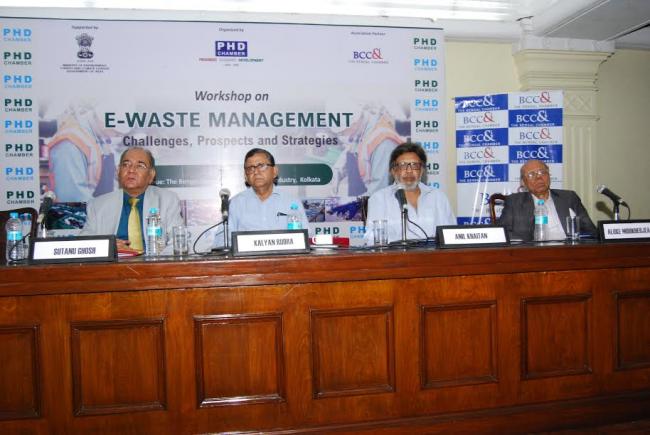
Organised in Kolkata, on Monday, the overall objective of 'E- Waste Management - Challenges, Prospects and Strategies & Hazardous Waste Management' was to provide an insight into various aspects of e-waste management with respect to the current situation and future scenario.
The agenda focused on the E-waste Management Rules set in 2016, regulatory compliance including roles and responsibility of the stake holders, Extended Producer Responsibility (EPR), role of informal sector in e-waste management, e-waste scenarios, opportunities and road map, sustainable E-waste management and perspectives of manufacturers, recyclers, etc.
Dr. Kalyan Rudra (Chairman, West Bengal Pollution Control Board), Anil Khaitan (Sr. Vice President, PHD Chamber of Commerce), Sutanu Ghosh (President, The Bengal Chamber), Dr. Subrata Mukherjee (I.F.S, Member Secretary, West Bengal Pollution Control Board), Kanchana Zutshi (Secretary, Environment Committee, PHD Chambers), Aloke Mookherjea (Past President, The Bengal Chamber) were present at the meet.
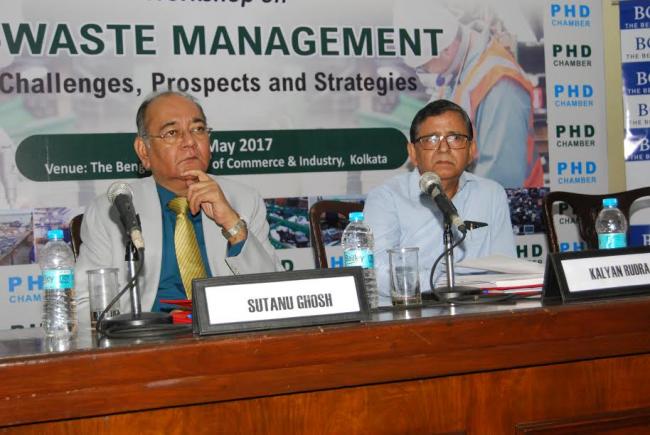 Dr Kalyan Rudra said, “India, produces around 1.7 million tonnes of e- waste annually resulting creating severe pressure on space and money to dispose these waste."
He said that the Pollution Control Board and the state government are conducting workshops to train the workers in building waste management skills and also in creating awareness among the people.
West Bengal has two e-waste management plants, one in Hooghly and the other in South 24 Parganas but more need to be pressed into service, he said.
Dr Rudra said, "It is the duty and responsibility of the manufacturers, producers, e-waste collectors, dealers, consumers and dismantlers to follow the guidelines provided by the Pollution Control Board to collect the E-waste, dismantle them an properly channelize them for a pre-treatment and disposal.”
India is said to be the fifth largest producer of e-waste.
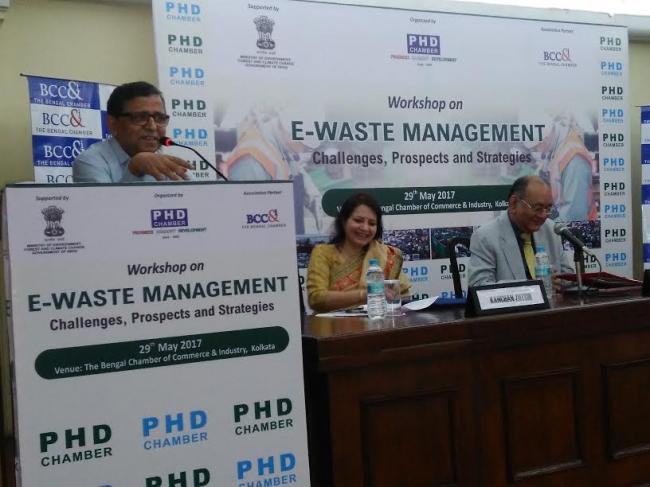 “To combat this e-waste problem, we need to create proper infrastructure for collection, storage, transport, recovery, disposal for national and regional for environment sound management of the places," said Anil Khaitan.
According to Sutanu Ghosh, “In India, 1.7 million tonnes of E-waste are generated every year, with an annual increase of five percent. The E-waste (Management) Rules 2016 notification, which supersedes the e-waste (Management & Handling) Rules, 2011 provides several options to manufacturers – such as collection of a refundable deposit and paying for the return of goods – to meet the requirements of law. The role of state government has been also introduced to ensure safety, health and skill development of the workers involved in dismantling and recycling operations.”
Support Our Journalism
We cannot do without you.. your contribution supports unbiased journalism
IBNS is not driven by any ism- not wokeism, not racism, not skewed secularism, not hyper right-wing or left liberal ideals, nor by any hardline religious beliefs or hyper nationalism. We want to serve you good old objective news, as they are. We do not judge or preach. We let people decide for themselves. We only try to present factual and well-sourced news.
Support objective journalism for a small contribution.