Trump tariffs are a power play, not about fairness: Raghuram Rajan
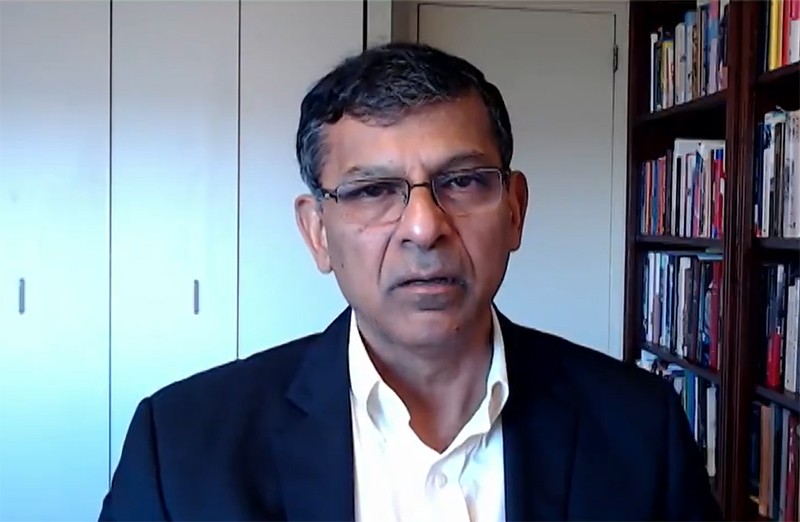
New Delhi: For former Reserve Bank of India Governor Raghuram Rajan, Donald Trump’s decision to slap a 50% duty on Indian goods is less about fairness and more about power.
“This is not about fairness, sovereignty, etc. We are talking about a situation where it is a power play,” Rajan said in an interview with India Today’s Rajdeep Sardesai.
He argued that tariffs are no longer just about trade economics, but part of a larger strategy to project political and economic might.
Rajan traced this worldview back to the 1980s, noting that Trump has long seen tariffs as a way to “level the playing field.” Beyond that, the former US President treats them as a tax on outsiders.
“Therefore it’s a cheap way of getting revenues, which can then help offset some of the tax cuts that he has made,” Rajan explained.
He added that tariffs had increasingly become a form of coercion in international politics.
“It can be a way for the US to essentially use force when it doesn’t want to use its military,” Rajan said. “Other countries suffer.”
India singled out
According to Rajan, India initially expected to be placed in the same tariff bracket as other Asian economies, at around 20%.
“We would look different, and we would be on a level playing field. Of course, there was a hope that the special Modi-Trump relationship would yield something even better. But at least we would not look worse if that had played out,” he said.
Instead, India was struck with a harsher 25% base tariff, while countries like Turkey, China and even the European Union—despite continuing trade with Russia—were spared such penalties.
“The fact that the Indian tariffs have been set at 25, the base tariffs, even while other countries are much lower in Asia, makes India disadvantaged. So the relationship clearly has broken down,” Rajan said.
Russia, oil and the bigger picture
Asked whether India’s purchase of discounted Russian crude had provoked Washington’s move, Rajan argued the issue ran deeper.
“I think we are beyond issues of fairness, sovereignty, etc. We are talking about a situation where it is a power play,” he reiterated.
He suggested the action stemmed from Trump’s belief that India was “not playing by the rules that he says, and needs to be singled out.”
Pointing to White House adviser Peter Navarro’s recent Financial Times article criticising India, Rajan said, “Navarro would not write in the Financial Times without permission. And he has been permissioned.”
A balancing act for India
Looking ahead, Rajan stressed the need for India to reassess the trade-offs of Russian oil.
“After all, there are refiners who are making excess profits. Do they still make those excess profits? Should we take some of those profits and benefit some of the exporters who are being hurt by the fact that they’re buying oil from Russia?” he asked.
In his view, the debate is no longer about principles alone. “It is an exercise of power,” Rajan concluded.
Support Our Journalism
We cannot do without you.. your contribution supports unbiased journalism
IBNS is not driven by any ism- not wokeism, not racism, not skewed secularism, not hyper right-wing or left liberal ideals, nor by any hardline religious beliefs or hyper nationalism. We want to serve you good old objective news, as they are. We do not judge or preach. We let people decide for themselves. We only try to present factual and well-sourced news.
Support objective journalism for a small contribution.