


‘Overwhelmed’ health systems have little room for sick refugees, migrants, UN agencies warn
New York/IBNS: Four prominent United Nations system entities have called on countries to protect refugees, migrants, stateless persons and those forcibly displaced by disasters and conflict – some of the world’s most vulnerable populations – against the rapidly expanding COVID-19 pandemic.
In a joint statement released today, the UN refugee agency (UNHCR), the International Organization for Migration (IOM), the UN human rights office (OHCHR) and the World Health Organization (WHO) stressed that refugees, migrants and displaced persons are at heightened risk of contracting the new coronavirus disease.
Human rights crucial to combatting COVID-19“Three quarters of the world's refugees and many migrants are hosted in developing regions where health systems are already overwhelmed and under-capacitated,” the statement reads. It notes that many of them live in overcrowded camps, settlements, makeshift shelters or reception centres, where they lack adequate access to health services, clean water and sanitation.
The joint statement voices particular concern about the situation for refugees and migrants held in formal and informal places of detention, including migrant children and their families as well as those detained without a sufficient legal basis.
“Considering the lethal consequences a COVID-19 outbreak would have, they should be released without delay”, the statement reads. “This disease can be controlled only if there is an inclusive approach which protects every individual's rights to life and health.”
The four agencies also stressed that Governments must do everything possible to protect the rights and health of all people, adding that doing so will in fact help control the spread.
Migrants and refugees, who are disproportionately vulnerable to exclusion, stigma and discrimination, must have equal access to health services and be effectively included in national responses to COVID-19 – including prevention, testing and treatment.
Meanwhile, countries around the globe are closing their borders and limiting cross-border movements to combat COVID-19. The four agencies stress in their statement that all such actions must be taken in full respect for human rights and refugee protection standards – including the principle of non-refoulement, or no forced return. Quarantines and health checks can help provide solutions.
Building host country capacity
While many nations protect and host refugee and migrant populations, they are often not equipped to respond to crises such as the current pandemic.
The joint statement emphasizes that States may require additional financial support to ensure that refugees and migrants they host enjoy adequate access to national health services. It notes that the world’s financial institutions can play a leading role in making those funds available.
“More than ever, as COVID-19 poses a global threat to our collective humanity, our primary focus should be on the preservation of life, regardless of status”, the statement reads, calling for a coherent, effective international approach that leaves no one behind.
Refugees playing active role, along with UN agencies
Amid the looming threat of potentially devastating virus outbreaks in in refugee and displaced persons camps around the world, UNHCR is liveblogging its robust preparation efforts.
In Kenya, distributions of food, jerry cans and soap are underway. Teams are providing hygiene kits to refugees in southern Yemen, as well as training sessions on safe behavior. In Syria, disbursements of direct cash assistance continue in displaced persons’ camps, with UNHCR staff observing social distancing protocols.
Today’s joint statement also makes clear that refugees, displaced, stateless people and migrants, have skills and resources that can actively help combat COVID-19.
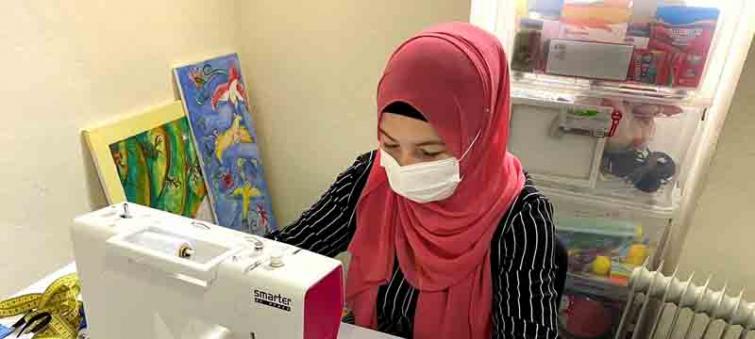
In Iran, refugees and Iranian women are working together to produce masks to keep health care workers safe. Meanwhile, in Kenya’s Kakuma refugee camp, a young refugee entrepreneur is accelerating his soap production to meet the camp’s increasing demand.
“We can only defeat this virus when each and every one of us is protected,” the statement concludes.
Photo caption and credit: UNICEF/ IOM Bosnia & Herzegovina Refugees and migrants at reception centres in Bosnia are sewing masks for use by others at the centre.
Support Our Journalism
We cannot do without you.. your contribution supports unbiased journalism
IBNS is not driven by any ism- not wokeism, not racism, not skewed secularism, not hyper right-wing or left liberal ideals, nor by any hardline religious beliefs or hyper nationalism. We want to serve you good old objective news, as they are. We do not judge or preach. We let people decide for themselves. We only try to present factual and well-sourced news.
Support objective journalism for a small contribution.


