


‘This is a time for facts, not fear,’ says WHO chief as COVID-19 virus spreads
New York/IBNS: The head of the World Health Organization (WHO) on Saturday cautioned against panic over COVID-19 but also urged governments to step up their efforts to prepare for the virus, saying “it’s impossible to predict which direction this epidemic will take.”
As the number of coronavirus cases reportedly passed 60,000, WHO Director-General Tedros Adhanom Ghebreyesus told foreign policy and security experts gathered for the Munich Security Conference that the UN agency was encouraged that there has not yet been widespread community transmission of the virus, now named COVID-19, outside of China.
WHO was also encouraged that “the global research community has come together to identify and accelerate the most urgent research needs for diagnostics, treatments and vaccines”, and that a team of international experts is now on the ground in China, working closely with Chinese counterparts to understand the outbreak, and to inform the next steps in the global response.
The virus emerged in central China in late December and the latest figures show it has infected more than 63,000 people and has killed some 1,300 patients, mostly in China. The WHO has classified COVID-19 a global health threat.
“The steps China has taken to contain the outbreak at its source appear to have bought to the world time,” Mr. Tedros said.
But ‘we don’t know how much time’
The WHO chief said the agency's encouragement was tempered by several key concerns, including, the rising number of cases in China, particularly the number of health workers that have been infected; the lack of urgency in funding the response from the international community; the levels of rumours and misinformation hampering the response; and the potential havoc the virus could wreak in countries with weaker health systems.
“The outbreaks of Ebola and COVID-19 underscore once again the vital importance for all countries to invest in preparedness and not panic,” said Mr. Tedros, recalling that two years ago, WHO and the World Bank founded the Global Preparedness Monitoring Board, an independent body to assess the state of the world’s readiness for a pandemic.
He said that last year, the board had published its first report, which concluded the world remains badly prepared.
“For too long, the world has operated on a cycle of panic and neglect. We throw money at an outbreak, and when it’s over, we forget about it and do nothing to prevent the next one...This is frankly difficult to understand, and dangerously short-sighted,” warned Mr. Tedros.
Next steps: scale up response, counter ‘infodemic’
Tedros outlined key requests of the international community on the way forward:
Use the window of opportunity provided by China’s quick action to intensify preparedness, including for the arrival of new cases, treating patients with dignity, and protecting health workers;
Push back against the ‘infodemic’, as fake news spreads faster and more easily than this virus, and is equally as dangerous. He called on governments, companies and news organizations to work with WHO to sound the appropriate level of alarm, without fanning the flames of hysteria; and
A “whole-of-government approach” approach must be coherent and coordinated, guided by evidence and public health priorities, as tackling the spread of the virus “is not a job for health ministers alone.
“We have a choice. Can we come together to face a common and dangerous enemy? Or will we allow fear, suspicion and irrationality to distract and divide us?” the WHO chief asked.
He said that in our fractured and divided world, health was one of the few areas in which international cooperation offered the opportunity for countries to work together for a common cause.
“This is a time for facts, not fear. This is a time for rationality, not rumours. This is a time for solidarity, not stigma,” Mr. Tedros concluded.
photo caption and credit:
Man Yi
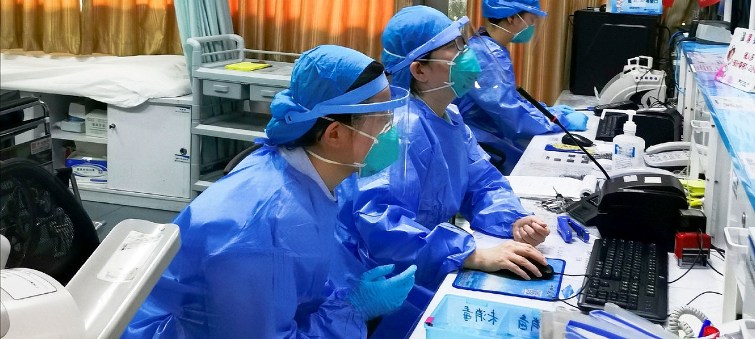
Emergency room nurses wear face masks at Second People's Hospital of Shenzhen in China.
Support Our Journalism
We cannot do without you.. your contribution supports unbiased journalism
IBNS is not driven by any ism- not wokeism, not racism, not skewed secularism, not hyper right-wing or left liberal ideals, nor by any hardline religious beliefs or hyper nationalism. We want to serve you good old objective news, as they are. We do not judge or preach. We let people decide for themselves. We only try to present factual and well-sourced news.
Support objective journalism for a small contribution.


