


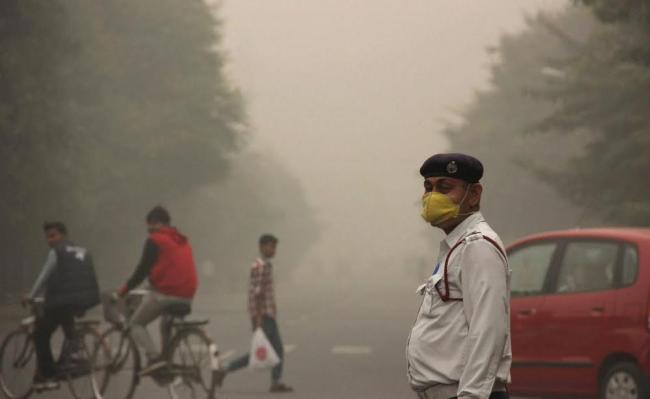
Air pollution has impact on childhood asthma: Study
New York, Apr 2 (IBNS): New research suggests that up to 38% of all annual childhood asthma cases in Bradford may be caused by air pollution.
The study, led by the University of Leeds, also shows traffic-related air pollution could be specifically responsible for up to 24% of the total number of cases.
An international team of researchers has used a newly-developed model to assess the impact exposure to nitrogen oxides – gases that make up air pollution – has on the development of childhood asthma.
Their study, published today in Environment International, used a model that knits together four distinct models of traffic, emissions, atmospheric dispersion and health impact assessments in Bradford. This allowed the researchers to chart the full chain of impact – from the source of air pollution through the pathways in which it impacts children’s health.
Study lead author Dr Haneen Khreis carried out this research while at the Institute for Transport Studies at Leeds. She said: "Overall rates of childhood asthma cases in Bradford are higher than the national average, as were emergency hospital admissions for asthmatic children under 16. Traffic-related air pollution is a real concern to the community."
"Our team’s previous research has shown that children exposed to high levels of traffic-related air pollution have a higher risk of developing asthma. Quantifying the number of childhood asthma cases that are directly attributable to traffic-related air pollution has not been done in the past and, as we show now, a significant portion of cases is largely preventable."
She added: "Our work demonstrates that while popular initiatives such as stopping vehicles from idling outside schools or providing walking routes away from roads are important, proposed solutions to mitigate traffic pollution shouldn’t be restricted to localised areas.
"New policies aimed at reducing the effects of traffic-related air pollution need to target each link in the full chain of events – from traffic volume and type, to exhaust and non-exhaust emissions, to dispersion to exposure."
The models used in the study allowed the team to chart how much air pollution is present in the city, and how much of that can be traced back to road traffic. By examining estimates of nitrogen oxide concentrations in Bradford, they were also able to estimate the levels of nitrogen dioxide – air pollutant produced as a result of road traffic. High concentrations of nitrogen dioxide can cause irritation to the respiratory system and significantly exacerbate existing respiratory problems.
The initial estimates of the model showed that 12% of the annual childhood asthma cases would be attributable to traffic related air pollution. However, the team knew the model was underestimating the traffic-related fraction of air pollution. After adjusting the results using actual measurements of air pollutants, it showed that up to 24% of the annual cases could be attributable to traffic-related air pollution.
Professor Nieuwenhuijsen said: "There is very little research that explores the impact of different exposure assessments. Cases of childhood asthma have been steadily increasing since the 1950s. Future progress with childhood asthma requires a focus beyond controlling and treating the disease toward asthma prevention starting with reducing traffic related air pollution."
The team’s research is part of ongoing work in Bradford assessing emissions and air quality profile in the region and the associated childhood health effects and impacts on the community.
Support Our Journalism
We cannot do without you.. your contribution supports unbiased journalism
IBNS is not driven by any ism- not wokeism, not racism, not skewed secularism, not hyper right-wing or left liberal ideals, nor by any hardline religious beliefs or hyper nationalism. We want to serve you good old objective news, as they are. We do not judge or preach. We let people decide for themselves. We only try to present factual and well-sourced news.
Support objective journalism for a small contribution.


