


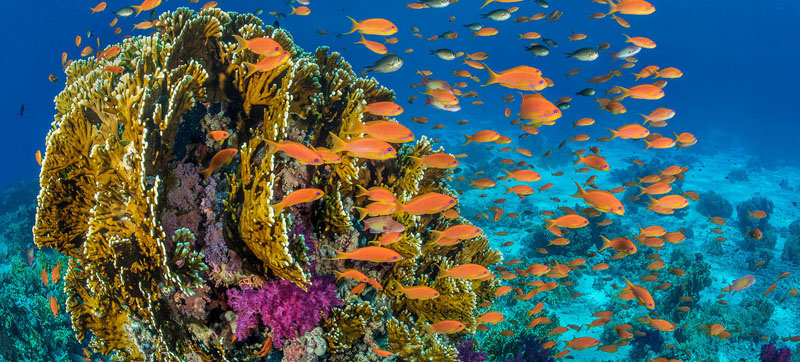
 Bio Diversity
Biodiversity at risk, threatens human survival, UN forum hears
New York: As the living tissue of the earth, biodiversity is “intimately linked to human health” the head of the UN’s scientific agency told a global forum on Wednesday, noting that “we are part of that living tissue”.
The Director-General of the UN Educational, Scientific and Cultural Organization (UNESCO), Audrey Azoulay opened the UNESCO Forum on Biodiversity by pointing out that one year after its emergence, the COVID-19 pandemic has confirmed what we had already known; “by threatening biodiversity, humanity is threatening the conditions for its own survival”.
“The pandemic demonstrated that human health depends on the health of living things”, she said flagging that it is “imperative to rethink our development models”.
Biodiversity protection is at the forefront of UNESCO’s ambition along with ocean sciences “to rebuild humanities relationship with nature and with living beings”, Ms. Azoulay stated.
50 years of protection
In kicking off the forum, Ms. Azoulay officially launched the 50th anniversary of UNESCO’s “Man and the Biosphere (MAB) programme, which envisioned territories where people could create new ways to enhance the relationship between people and nature.
“Fifty years later, this vision is no longer a mere theory, as 275 million people now live in the 714 UNESCO biosphere reserves in 129 countries”, she said, adding that together with the 252 World Heritage Sites and geoparks, “six per cent of the world’s land mass – equivalent to the surface of China – is protected”.
A super year
As a so-called “super year” for biodiversity, UNESCO will join with partners to set new objectives for the coming decade.
“Our goal is to preserve 30 per cent of the planet in protected areas”, Ms. Azoulay said, noting that caring for the planet means preserving the climate, protecting biodiversity and fighting against declining ocean health – another UNESCO priority.
Earlier this year, the UNESCO chief heralded the UN Decade of Ocean Science.
“We now have ten years to better understand and preserve the ocean, to reforge the relationship between humans and the seas and, in the process, to make important strides towards protecting biodiversity and the environment”, she said.
Nature studies
UNESCO is also strongly committed to enhancing education programmes dealing with the natural world, and has called on its 193 Member States to “better integrate sustainable development and nature into curricula”.
And to guarantee that education gives future generations the tools they need to save the planet, the UN agency is compiling a global framework of best practices in the field.
“Many other important milestones lie ahead of us –and this UNESCO Forum aims to be a launchpad for these major events”, she said, pointing to the IUCN World Conservation Congress in Marseille, the COP26 climate summit in Glasgow, and the COP15 biodiversity convention in Kunming.
“We need a collective commitment, which brings together civil society and the private sector”, the UNESCO chief said.
Building new relationships
Many other luminaries lent their voices to amplify the urgency of the situation, including Pope Francis, who urged everyone to see climate change as “much more of a moral than a technical issue”.
UN Sustainable Development Goals Advocate, Hindou Oumarou Ibrahim, warned that “if our environment disappears, who we are, our identity, and our way of life will disappear with it”.
UN Messenger of Peace, Jane Goodall, underscored the need “to develop a new relationship with the natural world and a new relationship with animals”.
And UN Special Envoy for the Ocean, Peter Thomson, underscored that “we cannot have a healthy planet without a healthy ocean.”
Support Our Journalism
We cannot do without you.. your contribution supports unbiased journalism
IBNS is not driven by any ism- not wokeism, not racism, not skewed secularism, not hyper right-wing or left liberal ideals, nor by any hardline religious beliefs or hyper nationalism. We want to serve you good old objective news, as they are. We do not judge or preach. We let people decide for themselves. We only try to present factual and well-sourced news.
Support objective journalism for a small contribution.


