


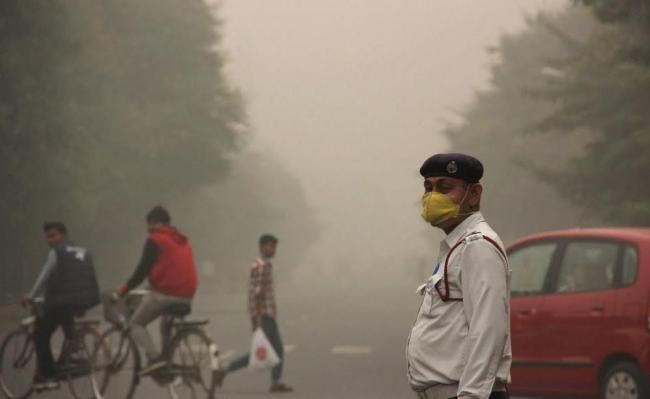
Climate change expected to increase premature deaths from air pollution, says study
The study, to appear in the July 31 advance online issue of Nature Climate Change, adds to growing evidence that the overall health effects of a changing climate are likely to be overwhelmingly negative. It is also the most comprehensive study yet on how climate change will affect health via air pollution, since it makes use of results from several of the world’s top climate change modeling groups.
“As climate change affects air pollutant concentrations, it can have a significant impact on health worldwide, adding to the millions of people who die from air pollution each year, ” said Jason West, who led the research at UNC-Chapel Hill with former graduate student and first author Raquel Silva.
Hotter temperatures speed up the chemical reactions that create air pollutants like ozone and fine particulate matter, which impact public health. Locations that get drier may also have worse air pollution because of less removal by rain, and increased fires and windblown dust. As trees respond to higher temperatures, they will also emit more organic pollutants.
West and Silva used an ensemble of several global climate models to determine the number of premature deaths that would occur due to ozone and particulate matter in 2030 and 2100. For each model, the team assessed the projected changes in ground-level air pollution that could be attributed to future climate change. They then overlaid these changes spatially on the global population, accounting for both population growth and expected changes in susceptibility to air pollution.
In aggregate, West and Silva found that climate change is expected to increase air pollution-related deaths globally and in all world regions except for Africa. Specifically, five out of eight models predicted there will be more premature deaths in 2030, and seven of nine models in 2100.
“Our finding that most models show a likely increase in deaths is the clearest signal yet that climate change will be detrimental to air quality and health,” said West, associate professor of environmental sciences and engineering in the UNC Gillings School of Global Public Health. “We also collaborated with some of the world’s top climate modeling groups in the United States, United Kingdom, France, Japan and New Zealand, making this study the most comprehensive yet on the issue.”
In addition to exacerbating air pollution-related deaths, climate change is expected to affect health through changes in heat stress, access to clean water and food, severe storms and the spread of infectious diseases.
Support Our Journalism
We cannot do without you.. your contribution supports unbiased journalism
IBNS is not driven by any ism- not wokeism, not racism, not skewed secularism, not hyper right-wing or left liberal ideals, nor by any hardline religious beliefs or hyper nationalism. We want to serve you good old objective news, as they are. We do not judge or preach. We let people decide for themselves. We only try to present factual and well-sourced news.
Support objective journalism for a small contribution.


