


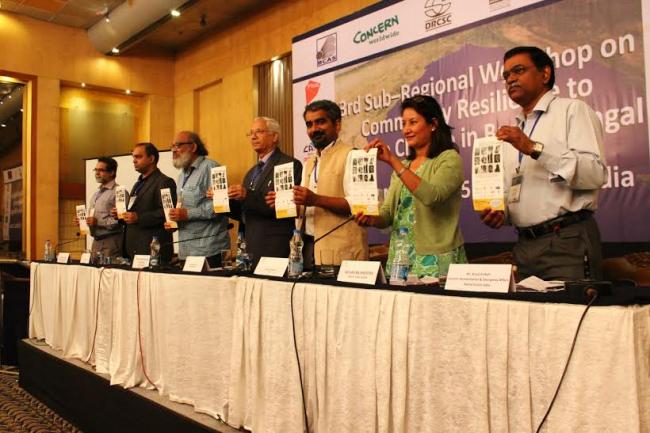
Climate Change to drastically change the face of the Bay of Bengal: Experts
The observation was made by Dr S Parasuraman, Director, Tata Institute of Social Sciences, while declaring open the 3rd Sub-Regional Workshop on Community Resilience to Climate Change in the Bay of Bengal.
The objective of the workshop is to create awareness and shape public opinion regarding the calamitous impact of global warming and climate change, and to enhance community resilience for sustainable development.
Apart from Dr Parasuraman, the event was attended by Dr Ambika Prasad Nanda (United Nations Development Programme), Dr Aniruddha Dey (Executive Director, PRISM), Ardhendu Chatterjee (DRCSC, Kolkata), Sanjay Vasisht (Director, CANSA) and Kunal Shah from World Vision India.
The Bay of Bengal harbouring all coastal countries; Bangladesh, India, Sri Lanka, Myanmar and Indonesia have the highest record of disasters historically.
The area affected by floods in India more than doubled between 1953 and 2003. In Bangladesh, 60% of the country is already flood-prone. For centuries, farmers, fishermen and others weather dependent livelihoods based communities in the Bay of Bengal region have adapted to periods of climate hardship.
Governments in the Bay of Bengal coast has formulated climate change policy and strengthened their efforts adapting to the adverse effects. In recent years, the development community has become increasingly concerned about damages & losses due to climate change impacts and intensified their efforts in climate change adaptation and risk reduction.
“One of the key groups affected by climate change are the children and youth in these countries and urgent steps need to be taken in order to overcome severe challenges that restrict their development,” said Kunal Shah from World Vision India, a Christian humanitarian organisation that serves all people regardless of religion, caste, race, ethnicity or gender.
Support Our Journalism
We cannot do without you.. your contribution supports unbiased journalism
IBNS is not driven by any ism- not wokeism, not racism, not skewed secularism, not hyper right-wing or left liberal ideals, nor by any hardline religious beliefs or hyper nationalism. We want to serve you good old objective news, as they are. We do not judge or preach. We let people decide for themselves. We only try to present factual and well-sourced news.
Support objective journalism for a small contribution.


