


Ebola cases no longer rising in Guinea, Liberia, UN health agency reports
Earlier today, UN Regional Humanitarian Coordinator for the Sahel, Robert Piper, had appealed for funding for Ebola preparedness in the swath of Africa consisting of Burkina Faso, Cameroon, Chad, Gambia, Mali, Mauritania, Niger, Nigeria and Senegal making up one of the poorest regions in the world.
WHO, in its most recent update, said the evolving Ebola outbreak “highlights the considerable risk of cases being imported into unaffected countries.”
“With adequate levels of preparation, however, such introductions of the disease can be contained before they develop into large outbreaks,” it said.
WHO attributed the success of Nigeria and Senegal in halting Ebola transmission to “strong political leadership, early detection and response, public awareness campaigns, and strong support from partner organizations.”
The United Nations and its partners are accelerating the deployment of preparedness strengthening teams to help countries build upon their existing work and planning, and this week, teams have been deployed to Benin, Burkina Faso, Gambia and Senegal, it said.
Meanwhile in Mali today, the head of the UN Mission for Ebola Emergency Response (UNMEER), Anthony Banbury, explored ways to support the Government not only in its efforts to end the current crisis, but to put in place the necessary capacity to react quickly should there be any new cases in the future.
There have been 6 reported cases of Ebola with 5 deaths in Mali to date.
Mr. Banbury met President Ibrahim Boubacar Keïta and the Minister of Health and Public Hygiene, Ousmane Koné, and praised their leadership in managing the crisis, including through the appointment of a national coordinator, Professor Samba Sow.
“A strong national leadership is an absolutely essential component of an effective response to the Ebola crisis,” Mr. Banbury said. “The President is playing that role and the United Nations is committed to supporting him and his government in bringing this crisis to a close.”
He also said there are two major differences in the situation in Mali as compared to the other affected countries. “One, there are many, many fewer cases. There's a just a small number now so that there's a chance to end the crisis before it spreads, before it becomes a real crisis the way we've seen it in the other countries.
Mr. Banbury said the second difference is that “we have the chance to learn from the lessons of the past, the experiences of the other countries, to take the actions that are necessary now to prevent it from spreading.” And while those might have been “unfortunate experiences” in the other countries, at least UNMEER knows what went wrong. “We know what we need to do to put the crisis to an end, and we have the chance to do that now here in Mali before it spreads so it doesn't kill more people in this country.”
The WHO report issued late today in Geneva said 15,145 cases of Ebola virus disease had been reported in six affected countries (Guinea, Liberia, Mali, Sierra Leone, Spain and the United States of America) and two previously affected countries (Nigeria and Senegal) with 5,420 reported deaths.
A total of 584 health-care workers are known to have been infected, 329 of whom have died, according to the report.
“In the three countries with widespread and intense transmission, reported case incidence is no longer increasing nationally in Guinea and Liberia, but is still increasing in Sierra Leone,” the report said.
“The outbreaks in Guinea and Liberia now appear to be driven by intense transmission in several key districts, whereas transmission is intense throughout the north and west of Sierra Leone,” where “the worst affected area remains the capital, Freetown,” it said.
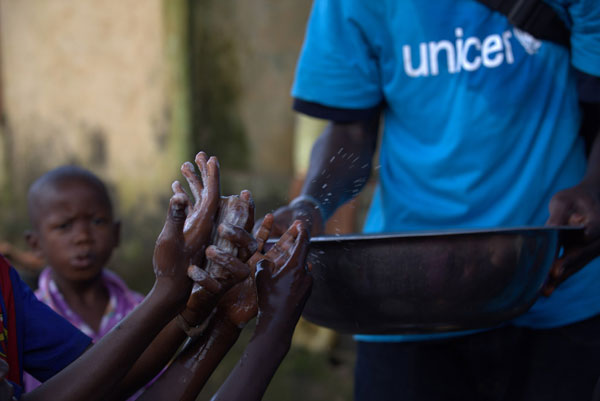
The report said the UN Children’s Fund (UNICEF) is the lead agency in social mobilization during this outbreak and that a joint WHO-UNICEF team visited Guinea, Liberia and Sierra Leone to review and assist them with their social mobilization plans.
WHO identified the 15 countries that have been prioritized for technical assistance on preparedness from specialist WHO teams and partners: Benin, Burkina Faso, Cameroon, Central African Republic, Cote D’Ivoire, Democratic Republic of Congo, Gambia, Ghana, Guinea Bissau, Mali, Mauritania, Nigeria, Senegal, South Sudan, and Togo.
In Conakry, Guinea, a mobilizer teaches children about proper handwashing techniques, which help prevent the spread of diseases, including Ebola. Photo: UNICEF/Timothy La Rose
Support Our Journalism
We cannot do without you.. your contribution supports unbiased journalism
IBNS is not driven by any ism- not wokeism, not racism, not skewed secularism, not hyper right-wing or left liberal ideals, nor by any hardline religious beliefs or hyper nationalism. We want to serve you good old objective news, as they are. We do not judge or preach. We let people decide for themselves. We only try to present factual and well-sourced news.
Support objective journalism for a small contribution.


