


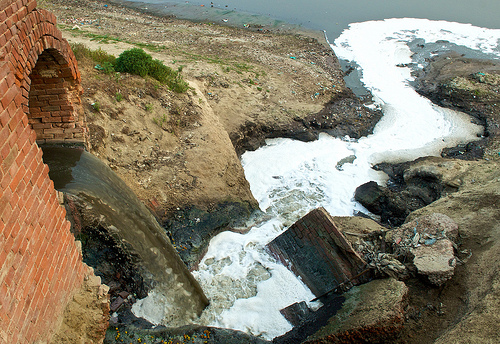
Environment ministry notifies revised standards for Common Effluent Treatment Plants
The primary aim of the revised standards is to minimise water pollution by significantly improving the performance of CETPs through implementation of design inlet quality, addressing the problems of the coastal pollution due to industrial discharges and keeping a close watch on the impact of discharge of industrial effluent on soil and ground water quality.
These standards were finalised after extensive consultations with industries and other stakeholders and detailed deliberations with the Central Pollution Control Board (CPCB). The revised standards were notified on January 1, 2016.
A provision of soil and groundwater quality monitoring twice a year (pre- and post-monsoon) has been introduced in the standards to study the impact of disposal of treated effluent on land, in case of mode of disposal as ‘on land for irrigation’. This monitoring will be carried out by the respective CETP management.
The mode of ‘Discharge into sea’ (marine outfalls) providing very high dilution will qualify for a relaxed maximum permissible concentration of Chemical Oxygen Demand (COD). The maximum permissible concentration of Fixed Dissolved Solids (FDS) by constituent units to CETP has been specified in terms of maximum allowable contribution value.
The State Pollution Control Boards are empowered to prescribe standards for Inlet quality of effluent in respect of Bio-chemical Oxygen Demand (BOD), Chemical Oxygen Demand (COD), Total Suspended Solids (TSS) and Total Dissolved Solids (TDS) considering CETP design and local needs & conditions. This provision will help in enforcing the norms for treated effluent quality for the CETP constituent industrial units.
The draft standards had been uploaded on the department's website, seeking views/comments of stakeholders including general public.
Image:- Ganga Action Parivar
Support Our Journalism
We cannot do without you.. your contribution supports unbiased journalism
IBNS is not driven by any ism- not wokeism, not racism, not skewed secularism, not hyper right-wing or left liberal ideals, nor by any hardline religious beliefs or hyper nationalism. We want to serve you good old objective news, as they are. We do not judge or preach. We let people decide for themselves. We only try to present factual and well-sourced news.
Support objective journalism for a small contribution.


