


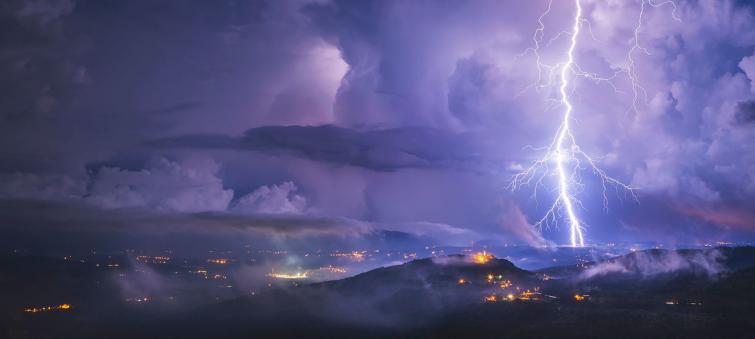
Extraordinary ‘megaflash’ lightening strikes cover several hundred kilometres, smashing records
New York/IBNS: New records for extreme lightning bursts, or ‘megaflashes’, during 2019, have been made official, more than doubling the size and duration of the previous record flashes, the UN’s weather agency, WMO, announced on Thursday.
Closing the windows and covering your pet’s ears probably wouldn’t have made much difference to anyone stuck in the middle of the flash that developed continuously over northern Argentina on 4 March 2019, lasting a whopping 16.73 seconds.
And the flash that stretched more than 700 kilometres (400 miles) across southern Brazil on 31 October last year, was equivalent to the distance between Boston and Washington DC in the United States, or between London, England, and Basel, Switzerland.
The previous megaflash distance record was 321 km (199.5 miles) on 20 June 2007, across the US state of Oklahoma, and the previous continuous duration record, was a puny-by-comparison 7.74 seconds, reached on 30 August 2012 in southern France.
Seen from space
The new record-breaking strikes, captured by the American Geophysical Union ahead of International Lightning Safety Day on 28 June, were recorded by equipment carried on the Geostationary Operational Environmental Satellites, and their orbiting counterparts from Europe and China.
The records were described by Professor Randall Cerveny, chief rapporteur of Weather and Climate Extremes for WMO, as “extraordinary”: “Environmental extremes are living measurements of what nature is capable of, as well as scientific progress in being able to make such assessments”, he added.
“It is likely that even greater extremes still exist, and that we will be able to observe them as lightning detection technology improves.”
Professor Cerveny said the technology could help scientists better understand the whole science of lightning, and potentially save lives: “This will provide valuable information for establishing limits to the scale of lightning – including megaflashes – for engineering, safety and scientific concerns.”
Stay inside
The WMO reiterated the dangers of lightning, and the many lives it claims every year.
Previous extreme examples have led to major loss of life: in 1975, for example, 21 people in Zimbabwe were killed when a single flash hit the hut in which they were sheltering, and 469 people were killed in Dronka, Egypt in 1994, when lightning tragically struck a set of oil tanks, causing burning oil to flood the town.
The official advice from the agency is to follow the 30-30 rule: if the time between flash and thunder is less than 30 seconds, stay inside, and wait 30 minutes after the last observed flash, to resume outdoor activities.
Support Our Journalism
We cannot do without you.. your contribution supports unbiased journalism
IBNS is not driven by any ism- not wokeism, not racism, not skewed secularism, not hyper right-wing or left liberal ideals, nor by any hardline religious beliefs or hyper nationalism. We want to serve you good old objective news, as they are. We do not judge or preach. We let people decide for themselves. We only try to present factual and well-sourced news.
Support objective journalism for a small contribution.


