


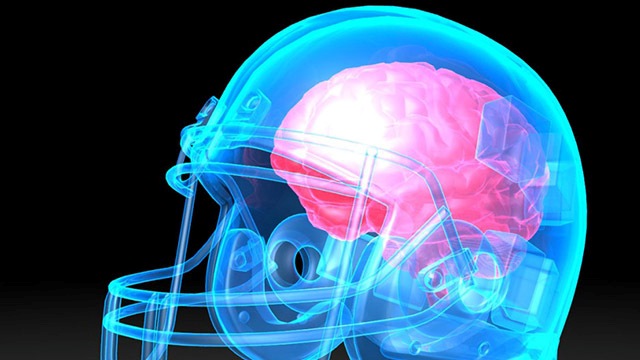
First study to show genotype may make some players more susceptible to concussion injuries
New York, Nov 10 (IBNS): A gene associated with dyslexia, a learning disorder, may make some athletes less susceptible to concussions, reports a new study from Penn State University and Northwestern Medicine.
This is believed to be the first time that this gene has been implicated in concussion or mild traumatic brain injury in athletes of a high-impact sport.
“This suggests that genotype may play a role in your susceptibility for getting a concussion,” said co-corresponding author Dr. Hans Breiter, a professor of psychiatry and behavioral sciences at Northwestern University Feinberg School of Medicine and director of the Northwestern Medicine Warren Wright Adolescent Center. “If replicated, this information may be important to parents.”
The paper was published in the Journal of Neurotrauma Oct. 23.
There are three variants of every gene. Athletes with one variant of the gene that did not confer dyslexia were more likely to have a history of concussion injuries. Athletes with the version of the gene that causes dyslexia were less likely to have concussion injuries.
The reason for the lower risk may relate to the more diffuse way the dyslexic brain is wired, said co-corresponding author Sam Semyon Slobounov, professor of kinesiology and of neurosurgery at Hershey Medical School of Penn State University and director of the Virtual Reality/Traumatic Brain Injury Research Laboratory. “Dyslexia may be neuroprotective, a hypothesis that could be tested,” he said.
“In dyslexia, you tend to have less defined wiring for processing spoken and written language,” Breiter said. “Dyslexics have a problem with that. Their wiring is more diffuse in this system. Future studies could directly test if diffuse wiring is better able to absorb a shock wave than clearly defined wiring.”
The study included 87 varsity Penn State football players from 2015 to 2017. The players reported their concussion history, which the team physician confirmed through each player’s medical evaluation and medical records of observable concussion signs as opposed to player reports of symptoms. Each player had a swab of his inner cheek taken, which was genetically analyzed.
The gene, KIAA0319, has not been looked at in concussion research before. Scientists decided to study it, along with a number of other candidate genes, because of its role in cell adhesion and neuron migration, said Alexa Walter, first author of the paper and a graduate student in kinesiology at Penn State. The gene KIAA0319 could have an effect on how neurons respond to head impacts or are repaired after an injury.
“This is one piece of the puzzle,” co-first author Amy Herrold said. The study is part of a larger project in the Concussion Neuroimaging Consortium, which studies the neuroscience of head impacts in athletes.
“This finding raises the question: are their particular factors we can determine that put players at higher risk, and should those players be placed in sports that don’t have the potential for head trauma?” Herrold said.
The genotype predicted the number of previously diagnosed concussions in the players. Everyone has the KIAA0319 gene in one of three combinations. In this gene, the genotypes are CC, CT or TT. There was a direct increase in diagnosed concussions as one went from CC to CT to TT individuals. The CC genotype has been associated with dyslexia in other studies.
Other authors on the paper are Virginia T. Gallagher, Rosa Lee, Madeleine Scaramuzzo, Tim Bream, Peter H. Seidenberg, David Vandenbergh, Kailyn O’Connor, Thomas M. Talavage and Eric A. Nauma.
The research was funded by Semyon Slobounov’s lab and Hans Breiter’s lab.
Support Our Journalism
We cannot do without you.. your contribution supports unbiased journalism
IBNS is not driven by any ism- not wokeism, not racism, not skewed secularism, not hyper right-wing or left liberal ideals, nor by any hardline religious beliefs or hyper nationalism. We want to serve you good old objective news, as they are. We do not judge or preach. We let people decide for themselves. We only try to present factual and well-sourced news.
Support objective journalism for a small contribution.


