


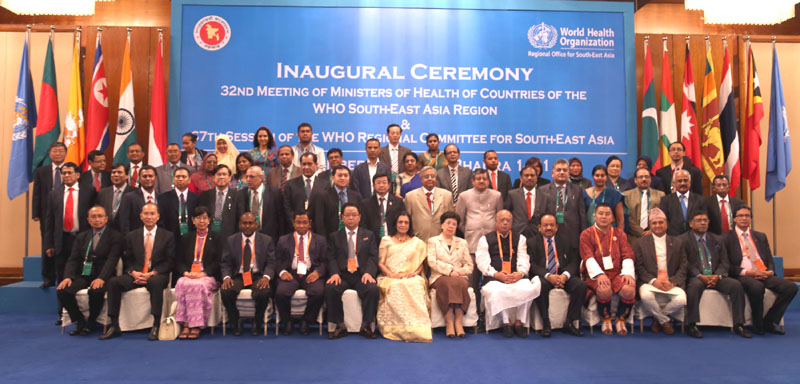
Harsh Vardhan calls for packing in "power of belief" in war on disease
Addressing the opening session of the 67th General Meeting of WHO Regional Committee at Dhaka today, the Indian Minister said, “Power of belief has also given us new hope, new energy, new enthusiasm and new vision to take on even greater health challenges.”
He stressed, “My Mantra for success is to find a way to convert health issues into a social and community movement. In my personal experience I have found tremendous value in involving adolescents and youth to communicate and disseminate messages of positive health. It is the power of community participation and partnership that can empower us to achieve what we seek to achieve. It can bring an end to preventable deaths, including child and maternal deaths.”
Harsh Vardhan recalled as an example of “power of belief” India’s triumph over Polio. In the mid-1990s, while conceiving the Pulse Polio mission, he had to encounter comments that it was an impossible thing to achieve given the ground conditions in India.
But eventually the collective will triumped.
He pledged India’s unequivocal support to the Dhaka Declaration on Vector-Borne Diseases which will be adopted at the four-day event.
The conference is being attended by health ministers from 11 countries.
The sessions to feature are traditional medicines, health workforce education, universal health coverage and civil registration.
Prime Minister of Bangladesh Sheikh Hasina inaugurated the event.
Bangladesh Health Minister Mohammad Nasim, WHO’s Director-General Dr Margaret Chan, and Regional Director Dr Poonam Khetrapal Singh were also present at the event.
Harsh Vardhan said, “The region is home to many vector-borne diseases. Malaria continues to be a threat. The region has become hyperendemic with regular reporting of dengue cases since 2000. Almost 67 percent of the people globally at risk of lymphatic filariasis reside in the region. About 147 million people in three countries - Bangladesh, India and Nepal - are at risk of Kala-azar.”
A Memorandum of Understanding (MoU) on Kala –azar control was signed during the day bringing on board Bhutan and Thailand. The existing MoU covers only India, Bangladesh and Nepal.
Stressing the “power of partnerships”, the Health Minister and his Bangladeshi counterpart, Mohammad Nasim, also inked an MoU on cooperation in the fields of traditional medicine and homoeopathy.
The agreement would cover exchanges of experts, training, mutual recognition of systems, qualification and pharmacopoeias, and provide further scope for research collaborations.
It will be in line with the “Delhi Declaration” adopted at the International Conference on Traditional Medicine for the South East Asian Countries in February 2013 calling for cooperation between the governments of the region.
“We must use the power of evidence, technology and effective communication. We must provide health assurance to our people through an assured package of preventive and positive health services, diagnostics and medicines. We need to promote traditional medicines and ancient healing systems such as Yoga,” he added.
Support Our Journalism
We cannot do without you.. your contribution supports unbiased journalism
IBNS is not driven by any ism- not wokeism, not racism, not skewed secularism, not hyper right-wing or left liberal ideals, nor by any hardline religious beliefs or hyper nationalism. We want to serve you good old objective news, as they are. We do not judge or preach. We let people decide for themselves. We only try to present factual and well-sourced news.
Support objective journalism for a small contribution.


