


 AI In Healthcare
Indi Setu London: Experts Urge Balance Between Clinical Insight and AI Efficiency in Healthcare
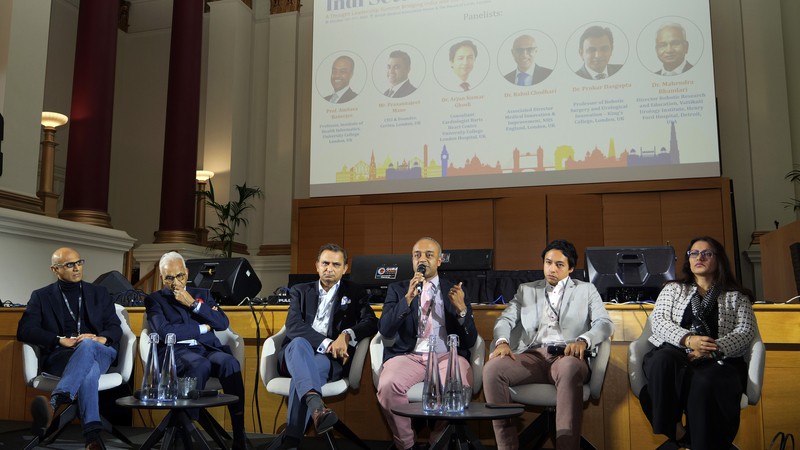
London/IBNS: At the Indi Setu Thought Leadership Summit in London last month, leading healthcare professionals and innovators examined how artificial intelligence (AI) can sharpen diagnosis, enhance precision, and improve efficiency — while underscoring the need for responsibility and human insight in its application.
Dr. Avi Mehra, Associate Partner and Chief Scientific Officer – Healthcare & Life Sciences at IBM, and Co-Founder of Doctorpreneurs, London, opened the discussion by acknowledging the dual-edged nature of AI’s rapid evolution.
“The breakneck speed of change can be fatiguing and overwhelming,” he said, cautioning that innovation must translate into meaningful clinical outcomes.
“Promise, practice, and pragmatism — these are the three keywords,” Dr. Mehra noted, as he introduced a panel of distinguished voices including Prof. Amitava Banerjee (University College London), Dr. Arjun K. Ghosh (Barts Heart Centre, UCLH), Dr. Mahendra Bhandari (Henry Ford Hospital, Detroit), Prof. Prokar Dasgupta, Dr. Rahul Chodhari (NHS England), and Prasannajeet Mane (Cerina, London).
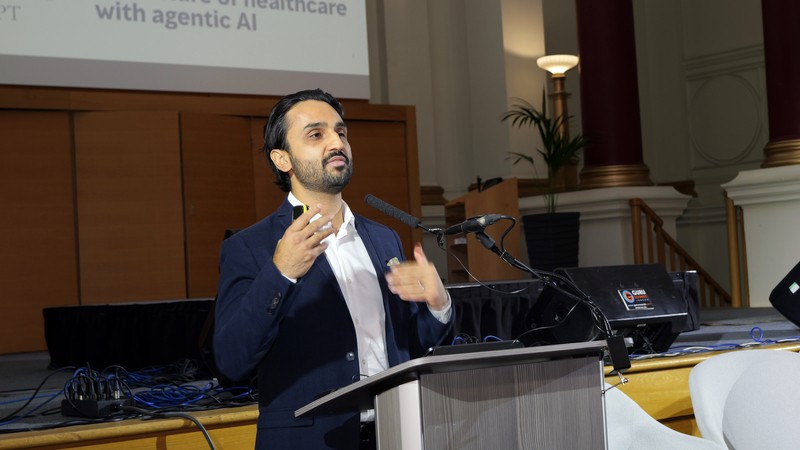 Dr. Avi Mehra emphasised “promise, practice, and pragmatism” as key pillars of AI in healthcare moderating the session. Photo: Organisers
“Patients don’t want an AI answer — they want clinical care,” said Dr. Arjun K. Ghosh, emphasising that artificial intelligence should support, not supplant, medical expertise.
“If we are able to fuse our understanding with these systems, we can use AI far more effectively in diagnosis,” he added.
Veteran urologist Dr. Mahendra Bhandari reflected on how technology has reshaped surgery. “Robotic surgery has demolished surgical ego and given us a new definition of precision,” he remarked.
Building on that, Prof. Prokar Dasgupta pointed out that AI has quietly powered healthcare for decades. “I like to call it medical intelligence. The systems we use for robotic surgery have existed for over 20 years,” he said. “Just because you don’t see what’s under the hood doesn’t mean it’s not there.”
Highlighting operational challenges, Dr. Rahul Chodhari of NHS England stressed, “We need AI to help increase the efficiency of the healthcare system,” adding that intelligent automation can relieve administrative burdens and allow clinicians to focus more on patient care.
Support Our Journalism
We cannot do without you.. your contribution supports unbiased journalism
IBNS is not driven by any ism- not wokeism, not racism, not skewed secularism, not hyper right-wing or left liberal ideals, nor by any hardline religious beliefs or hyper nationalism. We want to serve you good old objective news, as they are. We do not judge or preach. We let people decide for themselves. We only try to present factual and well-sourced news.
Support objective journalism for a small contribution.


