


 UNICEF
Lack of clean water far deadlier than violence in war-torn countries, says UNICEF report
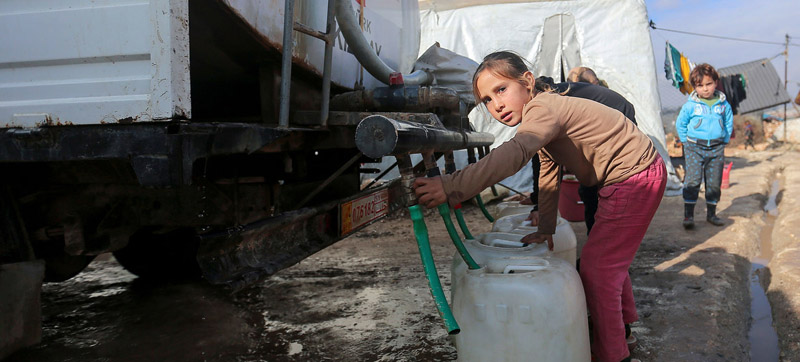
New York: Attacks on water and sanitation facilities in conflict zones around the world are putting the lives of millions of children around the world in danger, and are a much greater threat than violence itself, warns the UN Children’s agency, UNICEF, in a report released on Tuesday.
Water Under Fire Volume 3, highlights that children’s access to water has been threatened in nearly every conflict-related emergency where UNICEF is responding.
The report focuses on nine countries where violence and conflict are prevalent, and the impact the attacks have on children. Some 48 million people are estimated to need safe water and sanitation services in the follocountries (Central African Republic, Iraq, Libya, Palestine, Pakistan, Sudan, Syria, Ukraine, and Yemen).
‘Attacks on water and sanitation are attacks on children’
The protection of secure, reliable water and sanitation services is shown to be a critical factor in ensuring the survival of millions of children. The study notes that, in fragile countries, children under the age of five are 20 times more likely to die due to diarrhoeal diseases than to violence.
“Access to water is a means of survival that must never be used as a tactic of war,” said Manuel Fontaine, UNICEF Director of Emergency Programmes. “Attacks on water and sanitation infrastructure are attacks on children.”
“When the flow of water stops, diseases like cholera and diarrhoea can spread like wildfire, often with fatal consequences”, added Mr. Fontaine. “Hospitals cannot function, and rates of malnutrition and wasting increase. Children and families are often forced out in search of water, exposing them, particularly girls, to an increased risk of harm and violence.”
The report catalogues the devastating nature of attacks on water infrastructure: in Eastern Ukraine, for example, where some 3.2 million people needs water and sanitation services, 380 attacks have been recorded since 2017.
In the State of Palestine, there have been 95 attacks against 142 water and sanitation infrastructures since 2019, leaving more than 1.6 million people without access to these basic services.
And Yemen has seen 122 airstrikes on water infrastructure during the six-year-war. A cholera epidemic continues to make thousands of children ill every week, and around 15.4 million people urgently need safe water and sanitation.
Stop attacks immediately
UNICEF outlines a number of steps that should be urgently taken, to ensure that children are protected in conflict zones, and are guaranteed access to safe and sufficient water.
Parties to conflict, says the agency, must immediately ending attacks on water and sanitation services and personnel, and fulfilling their obligations to protect children in conflict.
The reports also calls for UN Member States, including Security Council members, to take firmer action to hold the perpetrators of these attacks to account; for donors to invest in water and sanitation in conflict situations; and for the public to add their voice to protect infrastructure, and water workers.
Support Our Journalism
We cannot do without you.. your contribution supports unbiased journalism
IBNS is not driven by any ism- not wokeism, not racism, not skewed secularism, not hyper right-wing or left liberal ideals, nor by any hardline religious beliefs or hyper nationalism. We want to serve you good old objective news, as they are. We do not judge or preach. We let people decide for themselves. We only try to present factual and well-sourced news.
Support objective journalism for a small contribution.


