


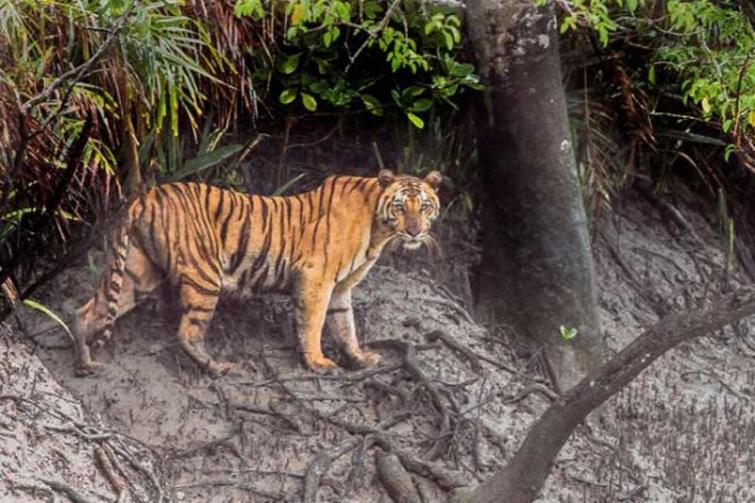
Low male tiger population in Bangladesh, worrisome: Official
Dhaka, Aug 9 (UNI) A lower-than-expected population of male Royal Bengal tigers in the world's largest mangrove forest has sparked fears about the long-term viability of the endangered species in Bangladesh, officials said here.
A poaching crackdown by authorities in the Bangladeshi part of Sundarbans mangroves saw an increase in the big cat population from 106 to 114 four years ago, according to a census published in May.
However, closer analysis of the data found that the number of male tigers was lower than the typical ratio of one male for every three tigresses, with the figure now at one male for every five females, officials said here on Wednesday.
'We are extremely worried. The standard ratio should be one male for every three female tigers,' Jahidul Kabir, government's conservator of forest wildlife, told this correspondent.
'In Sharonkhola range, we found only two males against 19 female tigers. The future of the tiger population in the Sundarbans could be at stake, if the forest continues to lose male tigers,' he warned.
Authorities are planning to capture male tigers from other parts of the forest and introduce them in Sharonkhola range, which is the densest tiger habitat in the mangroves.
The census was conducted on 1,656 sq km of forest last year and used camera traps, to count the big cats.
The Sundarbans, which also straddle parts of eastern India, is home to some rare flora and fauna, including Irrawaddy dolphins and Bengal tigers, both declared endangered, because of poaching and loss of habitat.
Alarm bells rang in 2015, when a census found that only 106 tigers were living in the forest, less than a quarter of the 440-strong population in 2004.
Since the 2015 findings, authorities have undertaken a series of measures to boost the number of Bengal tigers in the forest, one of the world's last remaining wild habitats for the big cats.
As part of the measures, the size of the wildlife sanctuary in the forest was more than doubled. An elite security force launched a major crackdown against pirates-turned-poachers, active in the forest.
Monirul Khan, a Zoology professor and a tiger expert at the state-run Jahangirnagar University, said he believed poaching was behind the low male tiger numbers.
No doubt, this is a worrying trend. And the possible reason is poaching, Mr Khan said. Male tigers are aggressive and they cover bigger territory, which make them vulnerable to poaching, he added.
Support Our Journalism
We cannot do without you.. your contribution supports unbiased journalism
IBNS is not driven by any ism- not wokeism, not racism, not skewed secularism, not hyper right-wing or left liberal ideals, nor by any hardline religious beliefs or hyper nationalism. We want to serve you good old objective news, as they are. We do not judge or preach. We let people decide for themselves. We only try to present factual and well-sourced news.
Support objective journalism for a small contribution.


