


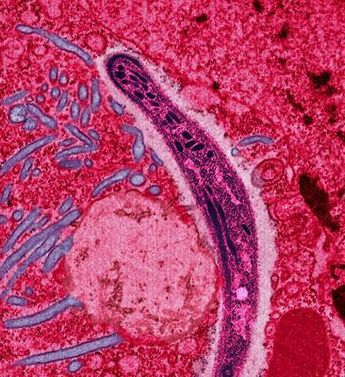
Malaria family tree has bird roots
Extensive testing of malarial DNA found in birds, bats and other small mammals from five East African countries revealed that malaria has its roots in bird hosts. It then spread from birds to bats and on to other mammals.
“We can’t begin to understand how malaria spread to humans until we understand its evolutionary history,” said lead author Holly Lutz, a doctoral candidate in the fields of Ecology and Evolutionary Biology and Population Medicine and Diagnostic Sciences at Cornell University. “In learning about its past, we may be better able to understand the effects it has on us.”
Lutz and her colleagues took blood samples from hundreds of East African birds, bats, and other small mammals and screened the blood for the parasites. When they found malaria, they took samples of the parasites’ DNA and sequenced it to identify mutations in the genetic code. From there, Lutz determined how different malaria species are related based on differences in their genetic code. Having large sample sizes from many species was key.
“Trying to determine the evolutionary history of malaria from just a few specimens would be like trying to reconstruct the bird family tree when you only know about eagles and canaries,” explained Lutz. “There’s still more to discover, but this is the most complete analysis of its kind for malaria to date.”
Humans cannot contract malaria directly from birds or bats. And while the study doesn’t have direct implications for malaria treatment in humans, co-author and Field Museum Curator of Mammals Bruce Patterson noted, “Malaria is notoriously adaptive to treatment, and its DNA holds a host of secrets about how it’s able to change and evolve. Having a better understanding of its evolutionary history could help scientists anticipate its future.”
Image: Wikimedia Commons
Support Our Journalism
We cannot do without you.. your contribution supports unbiased journalism
IBNS is not driven by any ism- not wokeism, not racism, not skewed secularism, not hyper right-wing or left liberal ideals, nor by any hardline religious beliefs or hyper nationalism. We want to serve you good old objective news, as they are. We do not judge or preach. We let people decide for themselves. We only try to present factual and well-sourced news.
Support objective journalism for a small contribution.


