


NASA-funded simulations show how massive collisions delivered metal to early Earth
Washington, Dec 6 (IBNS): Planetary collisions are at the core of our solar system’s formation. Scientists have long believed that after the Moon’s formation, the early Earth experienced a long period of bombardment that diminished about 3.8 billion years ago.
During this period, called “late accretion,” collisions with moon-sized planetary bodies, known as planetesimals, embedded extensive amounts of metal and rock-forming minerals into the Earth's mantle and crust.
It is estimated that approximately 0.5 percent of Earth’s present mass was delivered during this stage of planetary evolution, read the NASA website.
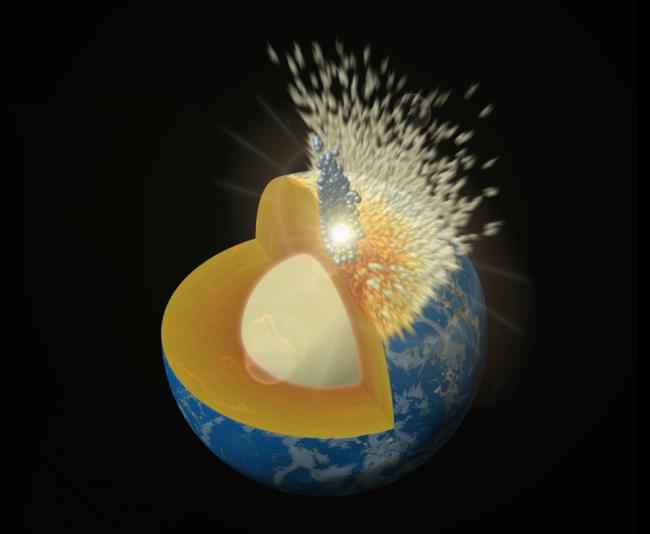
With the support from a NASA Exobiology grant and NASA’s Solar System Exploration Research Virtual Institute, or SSERVI, researchers at the Southwest Research Institute, or SwRI, and University of Maryland have created high-resolution impact simulations that show significant portions of a large planetesimal’s core could penetrate all the way down to merge with Earth’s core—or ricochet back into space and escape the planet entirely.
For a recently published paper in Nature Geoscience about the topic, Simone Marchi and his colleagues found evidence of more massive accretion onto the Earth than previously thought after the Moon’s formation.
The mantle abundances of certain trace elements such as platinum, iridium and gold, which tend to bond chemically with metallic iron, are much higher than what would be expected to result from core formation.
This discrepancy can most easily be explained by late accretion after core formation was complete.
The team determined the total amount of material delivered to Earth may have been 2-5 times greater than previously thought, and the impacts altered Earth in a profound way while depositing familiar elements like gold.
“These results have far-reaching implications for Moon-forming theories and beyond,” said Marchi. “Interestingly, our findings elucidate the role of large collisions in delivering precious metals like gold and platinum found here on Earth.”
Researchers at SwRI and the University of Maryland are part of 13 teams within SSERVI, based and managed at NASA’s Ames Research Center in California’s Silicon Valley. SSERVI is funded by the Science Mission Directorate and Human Exploration and Operations Mission Directorate at NASA Headquarters in Washington.
Image Credits: Southwest Research Institute/Simone Marchi
Support Our Journalism
We cannot do without you.. your contribution supports unbiased journalism
IBNS is not driven by any ism- not wokeism, not racism, not skewed secularism, not hyper right-wing or left liberal ideals, nor by any hardline religious beliefs or hyper nationalism. We want to serve you good old objective news, as they are. We do not judge or preach. We let people decide for themselves. We only try to present factual and well-sourced news.
Support objective journalism for a small contribution.


