


NASA selects scientists for Mars Rover research projects
The six new additions work in Alabama, Colorado, Indiana, Pennsylvania, Michigan and Tennessee. Eighty-nine scientists around the world submitted research proposals for using data from Curiosity and becoming participating scientists on the Mars Science Laboratory Project, which built and operates the rover.
The 28 selected by NASA are part of a science team that also includes about 120 other members, mainly the principal investigators and co-investigators for the rover's 10 science instruments, plus about 320 science-team collaborators, such as the investigators’ associates and students.
An initial group of Mars Science Laboratory participating scientists was chosen before Curiosity's 2012 landing on Mars, and several of those scientists were selected again in the latest round.
Participating scientists on the mission play active roles in the day-to-day science operations of Curiosity, involving heavy interaction with rover engineers at NASA's Jet Propulsion Laboratory, Pasadena, California. JPL manages the mission for NASA.
The six participating scientists who are new to the mission are: Barbara Cohen, of NASA Marshall Space Flight Center, Huntsville, Alabama; Christopher Fedo of the University of Tennessee, Knoxville; Raina Gough of the University of Colorado, Boulder; Briony Horgan of Purdue University, West Lafayette, Indiana; Christopher House of Pennsylvania State University, University Park; and Mark Salvatore of the University of Michigan, Dearborn.
Seven other newly selected participating scientists have participated in the Curiosity mission previously in other roles: Christopher Edwards, U.S. Geological Survey, Flagstaff, Arizona; Abigail Fraeman, JPL; Scott Guzewich, Universities Space Research Association, Greenbelt, Maryland; Craig Hardgrove, Arizona State University, Tempe; Amy McAdam, NASA Goddard Space Flight Center, Greenbelt, Maryland; Melissa Rice, Western Washington University, Bellingham; and Kathryn Stack Morgan, JPL.
Fifteen researchers who had been selected previously as Mars Science Laboratory participating scientists were selected again in this round: Raymond Arvidson, Washington University, St. Louis, Missouri; John Bridges, University of Leicester, United Kingdom; Bethany Ehlmann, California Institute of Technology, Pasadena; Jennifer Eigenbrode, NASA Goddard; Kenneth Farley, Caltech; John Grant, Smithsonian Institution, Washington; Jeffrey Johnson, Johns Hopkins University Applied Physics Laboratory, Laurel, Maryland; Richard Léveillé, McGill University, Montreal, Quebec, Canada; Kevin Lewis, Johns Hopkins University; Scott McLennan, State University of New York, Stony Brook; Ralph Milliken, Brown University, Providence, Rhode Island; John Moores, York University, Toronto, Ontario, Canada; David Rubin, University of California, Santa Cruz; Mariek Schmidt, Brock University, St. Catherines, Ontario, Canada; Rebecca Williams, Planetary Science Institute, Madison, Wisconsin.
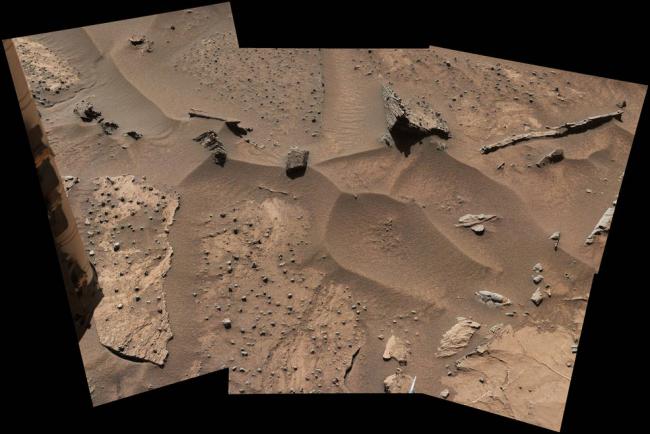
Credits: NASA/JPL-Caltech/MSSS
Support Our Journalism
We cannot do without you.. your contribution supports unbiased journalism
IBNS is not driven by any ism- not wokeism, not racism, not skewed secularism, not hyper right-wing or left liberal ideals, nor by any hardline religious beliefs or hyper nationalism. We want to serve you good old objective news, as they are. We do not judge or preach. We let people decide for themselves. We only try to present factual and well-sourced news.
Support objective journalism for a small contribution.


