


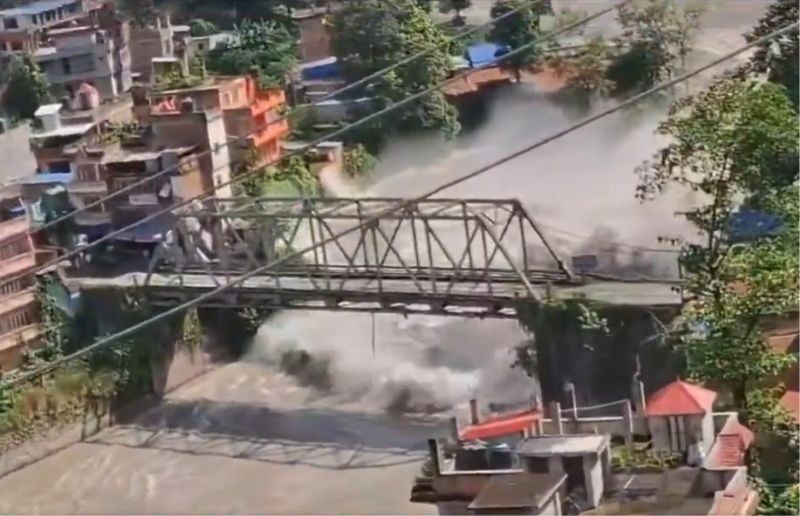
Nepal floods leave at least 72 dead, hundreds missing after suspected ice avalanche
At least 72 people have been killed and hundreds remain missing after powerful floodwaters tore through river valleys in Nepal and China's Tibet region on Wednesday, sweeping away settlements, bridges and infrastructure, according to New York Times.
The disaster has also left hundreds of tourists unaccounted for, with Nepal's tourism authorities reporting that 384 visitors, including 291 foreign nationals, were missing.
Suspected ice avalanche triggered floods
The cause of the sudden flooding remained under investigation. Nepal's Foreign Minister Shisir Khanal said the government had received preliminary information about an avalanche in the affected area.
This is seriously scary. CCTV footage from Gyirong Port in Tibet, China, directly opposite Nepal’s Rasuwa district. This flash flood hit here first and later caused massive havoc in Nepal. Can’t even imagine someone surviving this. Prayers for everyone affected. 🙏 https://t.co/o805P8KGSu pic.twitter.com/31QzZ64aBD
— Nikhil saini (@iNikhilsaini) August 26, 2026
Scientists studying the disaster believe an ice avalanche may have triggered the catastrophic flooding.
Simon Cook, a glaciologist at the University of Dundee, told The New York Times that an initial analysis of satellite imagery indicated that a large chunk of ice had broken away from a high-altitude glacier and plunged thousands of feet toward Nepal's Bhotekoshi River.
The impact may have generated enormous amounts of floodwater, Cook said, as the falling ice released vast amounts of energy and was pulverised.
“There was no rain in Nepal, so we were not expecting anything like this,” Narendra Pariyar, chief district officer of Rasuwa, told The New York Times.
Indian tourists among hundreds missing
Nepal's tourism board said 384 tourists had been reported missing, including 105 Indian nationals, around a dozen Britons and at least three Americans.
Visitors from Australia, the Netherlands, Malaysia and South Africa were also among those unaccounted for.
Authorities have not yet determined the full number of people missing or the scale of the destruction.
Today, a flash flood has swept through markets, settlements, and hydropower projects along the Bhotekoshi River in Timure and Syabrubesi, Gosainkunda Rural Municipality, Rasuwa District, Bagmati Province, Nepal. pic.twitter.com/DWVsGQpRzV
— Weather Monitor (@WeatherMonitors) August 26, 2026
Nepal Police spokesman Abi Narayan Kafle said personnel at four police posts and customs officials stationed at a land border crossing with China were also unaccounted for.
China border crossing overwhelmed
The flooding also caused major destruction at the Gyirong port of entry in Tibet, a key crossing between China and Nepal.
Chinese state news agency Xinhua reported “significant” casualties at the port.
Video footage verified by The New York Times showed people fleeing along a road as torrents of water and thick clouds swept through the area, engulfing buildings and parking lots.
These visuals from the floods in Rasuwa, Nepal are absolutely horrific. The scale of the destruction looks unreal, almost like a scene from a disaster movie.The entire Himalayan belt needs to seriously work on better early warning systems for such flash floods. Prayers for… pic.twitter.com/7iiupXXIzT
— Nikhil saini (@iNikhilsaini) August 26, 2026
Chinese President Xi Jinping ordered local authorities to make every effort to locate and rescue missing people.
Nepal steps up rescue operations
Nepali security forces, led by the army, have launched a major rescue operation. At least 114 people have been airlifted to safety, while the army has deployed 12 helicopters to the affected region.
A temporary hospital has also been established in the flood zone, with at least 25 seriously injured people evacuated to Kathmandu for treatment.
Bridges, schools and hydropower facilities were among the infrastructure reported to have been swept away as floodwaters surged downstream.
Government seeks help from India, China
The scale of the disaster has added to the challenges facing Nepal's newly elected government and its 36-year-old Prime Minister Balendra Shah.
Education Minister Sasmit Pokharel said Nepal had sought assistance from both India and China to bolster rescue and relief efforts as authorities struggled to reach affected communities and assess the devastation.
Support Our Journalism
We cannot do without you.. your contribution supports unbiased journalism
IBNS is not driven by any ism- not wokeism, not racism, not skewed secularism, not hyper right-wing or left liberal ideals, nor by any hardline religious beliefs or hyper nationalism. We want to serve you good old objective news, as they are. We do not judge or preach. We let people decide for themselves. We only try to present factual and well-sourced news.
Support objective journalism for a small contribution.


