


 Cancer
‘Smart’ drug knows where to strike: Indian scientists target Cancer cells, spare healthy tissue
Indian scientists have developed a new “smart” cancer drug designed to activate primarily inside cancer cells, potentially offering a more targeted alternative to conventional chemotherapy, which can also damage healthy cells.
Cancer treatments often affect healthy cells along with cancerous ones, resulting in significant adverse effects and side effects. This has created a growing need for targeted therapies that remain inactive in normal tissues as they travel through the body but become activated specifically at tumour sites.
Scientists have now taken an important step towards making this approach a reality.
Collaborative research led by Dr Asis Bala of the Institute of Advanced Study in Science and Technology (IASST), an autonomous institute under the Department of Science and Technology, Government of India, and Dr K.P. Bhabak of the Indian Institute of Technology Guwahati has resulted in the development of a new “smart” cancer drug candidate called RK-251.
RK-251 is designed to become active primarily inside cancer cells, while causing minimal damage to healthy cells.
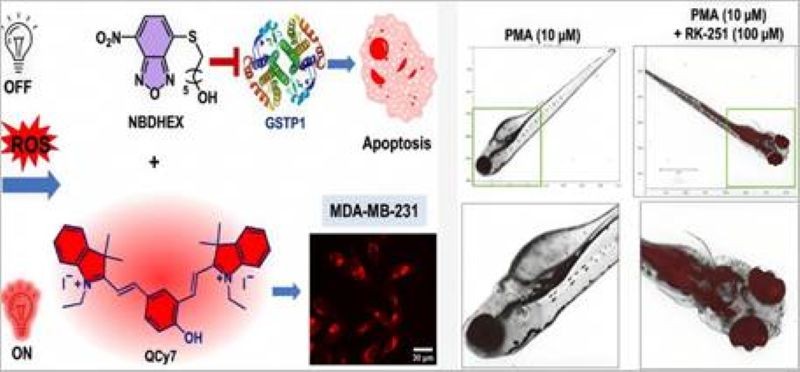
Cancer cells often produce elevated levels of reactive oxygen species (ROS), harmful molecules that can be exploited as a biological trigger. When RK-251 enters a cancer cell, the high levels of ROS are designed to activate the drug, releasing a potent anticancer compound called NBDHEX.
NBDHEX targets proteins that many cancer cells rely on for survival and resistance to treatment, potentially helping to kill cancer cells while limiting damage to surrounding healthy tissue.
In preclinical studies, RK-251 demonstrated strong activity against aggressive triple-negative breast cancer cells, while showing considerably less effect on healthy cells.
Researchers also studied the drug candidate in zebrafish embryos (Danio rerio). The experiments showed no obvious signs of toxicity, while the compound exhibited the expected fluorescence in the presence of reactive oxygen species, providing additional evidence supporting its mechanism of action and warranting further investigation.
However, RK-251 remains at the preclinical research stage. Further laboratory studies and validation, including appropriate clinical trials, will be required before the drug can be tested in humans or considered for potential medical use.
Support Our Journalism
We cannot do without you.. your contribution supports unbiased journalism
IBNS is not driven by any ism- not wokeism, not racism, not skewed secularism, not hyper right-wing or left liberal ideals, nor by any hardline religious beliefs or hyper nationalism. We want to serve you good old objective news, as they are. We do not judge or preach. We let people decide for themselves. We only try to present factual and well-sourced news.
Support objective journalism for a small contribution.


