


 Typhoon
‘Super typhoon’ Goni: Towns cut off as COVID-19 impacts response
New York: “Super storm” Typhoon Goni has left several towns inaccessible and destroyed thousands of homes in the Philippines, the UN humanitarian wing has said, adding that relief efforts have been complicated by the coronavirus pandemic.
The Bicol region – where typhoon Goni made its landfall on Sunday – currently has some 425 active COVID-19 cases and the risk of transmission remains high, especially in typically crowded evacuation centres, according to the UN Office for Coordination of Humanitarian Affairs (OCHA).
About 361,000 people are sheltering in evacuation centres across the affected regions while another 54,400 are hosted by relatives and friends. Bicol’s main COVID-19 laboratory has also sustained damage, prompting the suspension of testing.
The UN International Organization for Migration (IOM), one of the UN agencies involved in the response, warned that with the coronavirus pandemic, “the most vulnerable displaced populations have become even more vulnerable.”
“IOM will continue to work with our Government partners to support their monumental recovery efforts to address the most urgent humanitarian needs,” said the UN agency’s Chief of Mission in the Philippines, Kristin Dadey.
Emphasizing the critical need for proper COVID-19 precautionary measures in evacuation sites, IOM will deliver assorted personal protective equipment (PPE) including 200,000 face masks, 20,000 bottles of sanitizer, 2,000 face shields, and 500 modular tents to the Philippine Department of Social Welfare and Development and the the country’s Coast Guard.
Authorities are also deploying personnel to monitor COVID-19 symptoms among the displaced.
On the ground, assessing damage
Humanitarian teams are on the ground in some of the hardest hit areas, assessing damage.
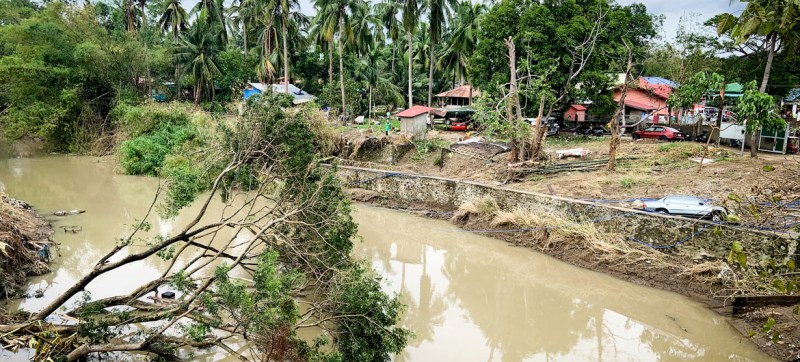
After making landfall in Bicol, typhoon Goni (known locally as Rolly) hit the town of Tiwi in Albay province, causing rivers to overflow and flood much of the region. Thus far, some 11 towns are reported to be cut off and at least 10,000 houses destroyed or damaged, including more than 300 houses buried under volcanic rock.
Power lines and telecommunication links are also disrupted.
Initial reports indicate damage to some 16,900 hectares of cropland, affecting about 18,000 farmers, with production losses estimated at 66,600 metric tons of rice, corn and high-value crops, valued at about $24 million.
Source: OCHA | Path of Super Typhoon Goni. Click here for details.
Eleven people were reported killed in Catanduanes and Albay provinces from the onslaught of the typhoon. Numbers are feared to increase in the coming days.
Goni made two other landfalls in Quezon and Batangas provinces, progressively weakening as it crossed the Philippines Monday, sparing the capital Manila.
Humanitarian response continues
Meanwhile, UN agencies continue their response efforts. The UN Development Programme (UNDP) has provided provincial authorities in Albay with satellite imagery of affected areas.
The UN International Organization for Migration (IOM) has deployed teams to Bicol and Regional IV to assess the needs of displaced persons. It has also rolled out its guidelines on COVID-19 and camp coordination and camp management (CCCM) and protection.
The UN Food and Agriculture Organization (FAO) will help assess the damage to agriculture as well as rehabilitation of agri-facilities. The UN Children’s Fund (UNICEF) has pre-positioned water and sanitation (WASH) items, tents for child-friendly spaces, and education materials, which can be released to partners as needed.
The humanitarian organization, International Federation of Red Cross and Red Crescent Societies (IFRC), has dispatched 1,000 non-food-item (NFI) kits, while the Philippine Red Cross has deployed search and rescue teams in flooded communities and continues to provide relief assistance and psycho-social support to displaced people in evacuation centres.
Support Our Journalism
We cannot do without you.. your contribution supports unbiased journalism
IBNS is not driven by any ism- not wokeism, not racism, not skewed secularism, not hyper right-wing or left liberal ideals, nor by any hardline religious beliefs or hyper nationalism. We want to serve you good old objective news, as they are. We do not judge or preach. We let people decide for themselves. We only try to present factual and well-sourced news.
Support objective journalism for a small contribution.


