September 20, 2026 09:16 pm (IST)

Follow us:


Syria: UN adapts to meet needs of Palestinian refugees
New York, May 21 (IBNS): The health department of the UN agency assisting Palestinian refugees across the Middle East on Tuesday reported that more than half of its health centres in Syria are destroyed or non-functional, even as life expectancy is on the rise for Palestinians in the region with a growing ageing population suffering from sedentary lifestyles.
In its annual health report, the UN Relief and Works Agency for Palestine Refugees in the Near East (UNRWA) said there has been “remarkable progress” in reducing deaths and disease such as tuberculosis, pregnancy-related deaths and infant deaths from measles and meningitis.
“Life expectancy is growing, but aging populations are suffering from sedentary life styles and the global pandemic of non-communicable disease (NCDs),” UNRWA, has been the main provider of primary health care for Palestine refugees for over six decades, said in a news release referring to diseases such as diabetes and hypertension.
The focus of this year’s report is on Syria where three years of conflict have taken a heavy toll on the country’s infrastructure, with hospitals and medical clinics targeted or sometimes used by fighting groups.
“It has been a huge challenge, but we have been able to respond to a devastating situation,” said Akihiro Seita, UNRWA Director of Health, launching the reports in Geneva.
The UN agency has established ten ‘health points’ and intensified services at those clinics which are working.
“We have established eight health points in Damascus and two in Aleppo,” Dr. Seita said. “They have allowed us to continue desperately needed consultations, even though more than 50 per cent of our twenty-three clinics have been destroyed or rendered non-functional.”
In addition, UNRWA has reassigned health professionals to facilities that are housing refugees, such as schools, allowing the UN agency to provide medical services round the clock.
The Agency has also increased cash subsidies for UNRWA patients seeking treatment in non-UNRWA hospitals, “but weakened health systems and poor access to health care have seen outbreaks of infectious and communicable diseases such as polio and hepatitis increase,” according to Dr. Seita.
Meanwhile, the health situation in the Yarmouk refugee camp in Damascus “continues to deteriorate,” Gunness said, with only a quarter of the required minimum food needs being met in the camp since January.
The UN agency is urgently seeking permission from the authorities to resume its food distribution operations. UNRWA was last allowed access to the camp a week ago.
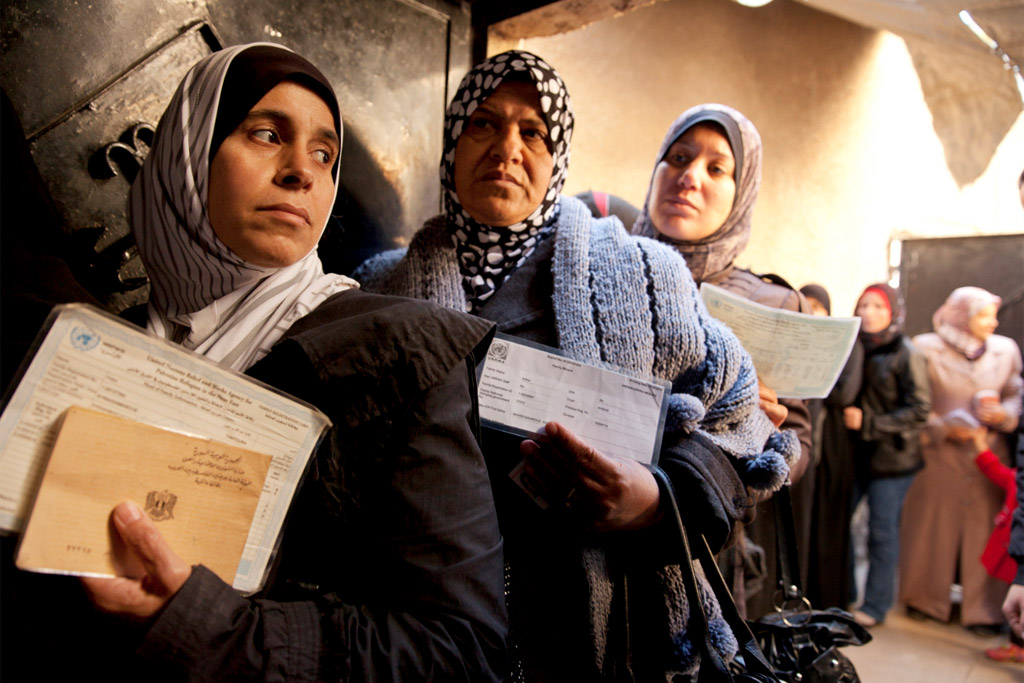
(Palestinian women at a UNRWA distribution centre in the Jaramana refugee camp, Damascus, Syria. Photo: UNRWA/Carole Alfarah)
Support Our Journalism
We cannot do without you.. your contribution supports unbiased journalism
IBNS is not driven by any ism- not wokeism, not racism, not skewed secularism, not hyper right-wing or left liberal ideals, nor by any hardline religious beliefs or hyper nationalism. We want to serve you good old objective news, as they are. We do not judge or preach. We let people decide for themselves. We only try to present factual and well-sourced news.
Support objective journalism for a small contribution.


Latest Headlines