


UN-backed action plan to improve study of weather and climate in Polar regions takes shape
“Advances in Polar prediction will lead to improvements in weather forecasts, climate predictions and, ultimately, better services for those who live and work in these higher latitudes as well as those living in the lower-latitude regions,” said WMO President David Grimes in a press release issued by the agency today.
A conference held in Geneva from 13-15 July, which grouped operational weather and climate prediction centres, environmental experts, researchers, funding agencies and the shipping and tourist sectors, finalized plans for a Year of Polar Prediction. The Year will take place from mid-2017 to mid-2019, in order to cover an entire year in both the Arctic and Antarctic, and will seek to accelerate and consolidate research, observing, modelling, verification and educational activities as part of a wider Polar Prediction Project.
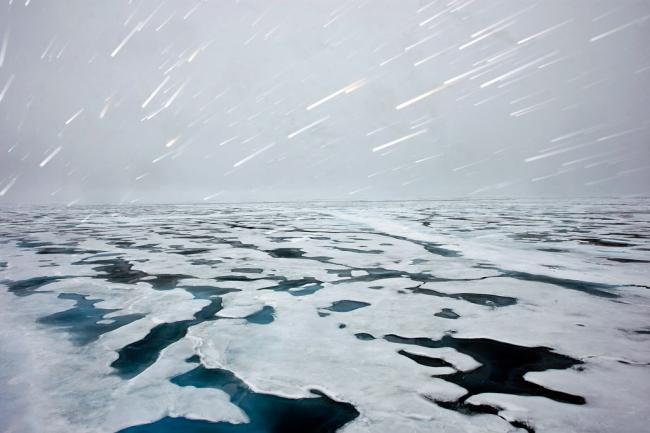
There is growing interest in the Polar Regions, fueled by concerns about the rapid pace of climate change, WMO said. The Arctic is heating at roughly twice the global average rate, with consequent reductions in ice and snow cover and melting of glaciers and permafrost. The impact of this is not confined to the Arctic, but is felt in other parts of the globe – as exemplified by rising sea levels and changing weather and climate patterns.
Polar regions which were previously difficult to access are now opening up to economic, transportation and tourism activities, leading to more demands for better predictions. However, the agency said that lack of observations and scientific understanding currently makes weather, water, ocean, wave and sea ice forecasting very challenging.
“Climate change comes with opportunities, such as reduced maritime transport time from Europe to Asia, and risks such as oil spills and ship accidents. We need improved predictive capacity to manage both the opportunities and the risks,” said Thomas Jung, of Germany’s Alfred Wegener Institute Helmholtz-Centre for Polar and Marine Research, and chair of the Polar Prediction Project steering committee.
But potential economic benefits come at a price – and not just the negative implications of climate change for global society. An increase in Arctic shipping might result in more oil spills. “A large spill in the Arctic would present a massive challenge,” warned Petter Meier Deputy Director General of Norway’s Ministry of Transport and Communications.
“None of the Arctic States currently have the capacity to respond to an oil spill. We need effective preventive measures because we simply cannot afford to jeopardize the marine environment,” said Meier, stressing that toxic effects of Arctic oil spills may last longer because there are fewer organisms to break down the oil.
More accurate weather forecasts and predictions are also needed in Antarctica to provide better logistical support for research activities and tourism, adds WMO.
UN Photo/Mark Garten (file)
Support Our Journalism
We cannot do without you.. your contribution supports unbiased journalism
IBNS is not driven by any ism- not wokeism, not racism, not skewed secularism, not hyper right-wing or left liberal ideals, nor by any hardline religious beliefs or hyper nationalism. We want to serve you good old objective news, as they are. We do not judge or preach. We let people decide for themselves. We only try to present factual and well-sourced news.
Support objective journalism for a small contribution.


