


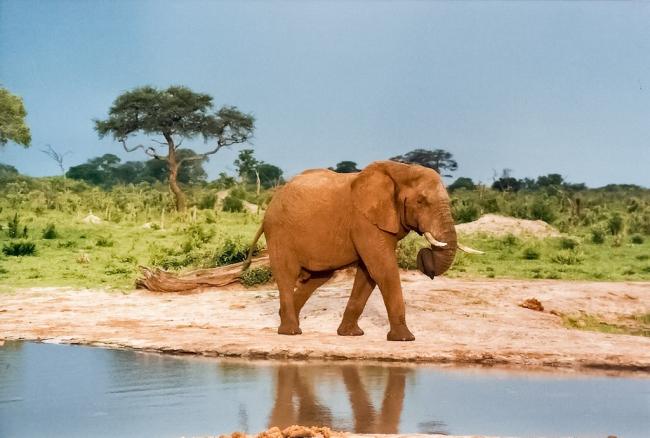
WWF report reveals staggering extent of human impact on planet
New York, Oct 30 (IBNS): Humanity and the way we feed, fuel and finance our societies and economies is pushing nature and the services that power and sustain us to the brink, according to WWF’s Living Planet Report 2018.
The report presents a sobering picture of the impact of human activity on the world’s wildlife, forests, oceans, rivers and climate, underlining the rapidly closing window for action and the urgent need for the global community to collectively rethink and redefine how we value, protect and restore nature.
The Living Planet Report 2018 presents a comprehensive overview of the state of our natural world, through multiple indicators including the Living Planet Index (LPI), which examines trends in global wildlife abundance. Tracking 16,704 populations of 4,005 vertebrate species, the LPI finds that global populations of mammals, birds, fish, reptiles, and amphibians have declined, on average, by 60 percent between 1970 and 2014, the most recent year with available data.
The top threats to species identified in the report are directly linked to human activities, including habitat loss and degradation and overexploitation of wildlife.
“This report sounds a warning shot across our bow. Natural systems essential to our survival – forests, oceans, and rivers – remain in decline. Wildlife around the world continue to dwindle,” said Carter Roberts, President and CEO of WWF-US. “It reminds us we need to change course. It’s time to balance our consumption with the needs of nature, and to protect the only planet that is our home.”
Over recent decades, human activity has also severely impacted the habitats and natural resources wildlife and humanity depend on, such as oceans, forests, coral reefs, wetlands and mangroves. The Earth is estimated to have lost about half of its shallow water corals in the past 30 years and 20 percent of the Amazon has disappeared in just 50 years.
“From rivers and rainforests, to mangroves and mountainsides, across the planet our work shows that wildlife abundance has declined dramatically since 1970. The statistics are scary, but all hope is not lost. We have an opportunity to design a new path forward that allows us to co-exist sustainably with the wildlife we depend upon. Our report sets out an ambitious agenda for change. We are going to need your help to achieve it,” said Prof. Ken Norris, Director of Science at the Zoological Society of London (ZSL), the organization responsible for providing the LPI.
The Living Planet Report 2018 also focuses on the value of nature to people’s health and that of our societies and economies. Globally, nature provides services worth around $125 trillion a year, while also helping ensure the supply of fresh air, clean water, food, energy, medicines and more.
A roadmap for action on nature - for 2020 and beyond
Evidence shows that the two agendas for the environment and human development must converge if we are to build a sustainable future for all. The Living Planet Report 2018 highlights the opportunity the global community has to protect and restore nature leading up to 2020, a critical year when leaders are expected to review the progress made on landmark multilateral pacts to solve global challenges including the Sustainable Development Goals, the Paris Climate Agreement and the Convention on Biological Diversity (CBD).
Hope is not lost, but urgent action is needed. Recent population increases in giant pandas, mountain gorillas and the critically endangered dolphins of the Mekong River show that sustained conservation efforts work. National-level action like the US Endangered Species Act - which since enacted in 1973 has helped an estimated 99 percent of listed species avoid extinction – demonstrate what is possible when wildlife conservation and biodiversity are prioritized. A global deal for nature, similar to the Paris Climate Agreement, can ensure that effective conservation methods continue, and more ambitious goals are set.
WWF is calling on people, businesses and governments to mobilize and deliver on a comprehensive framework agreement for nature and people under the CBD. This can galvanize public and private action to protect and restore global biodiversity and nature and bend the curve on the devastating trends highlighted in the report.
The Living Planet Report 2018 is the twelfth edition of WWF's biennial flagship publication. Through indicators such as the LPI, the Species Habitat Index (SHI), the IUCN Red List Index (RLI) and the Biodiversity Intactness Index (BII), as well as Planetary Boundaries and the Ecological Footprint, the report paints a singular disturbing picture: human activity is pushing the planet’s natural systems that support life on earth to the edge.
Support Our Journalism
We cannot do without you.. your contribution supports unbiased journalism
IBNS is not driven by any ism- not wokeism, not racism, not skewed secularism, not hyper right-wing or left liberal ideals, nor by any hardline religious beliefs or hyper nationalism. We want to serve you good old objective news, as they are. We do not judge or preach. We let people decide for themselves. We only try to present factual and well-sourced news.
Support objective journalism for a small contribution.


