


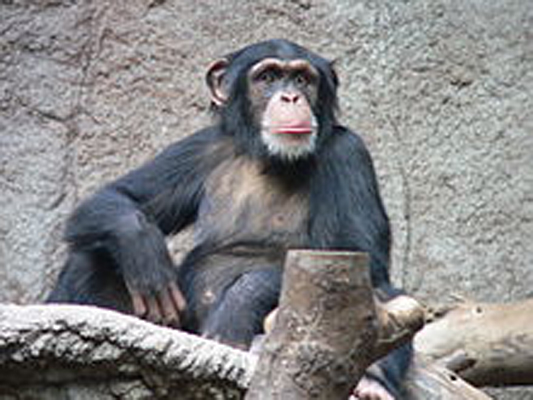
Yale-led study: Wild chimpanzees have surprisingly long life spans
The study, published March 19 in the Journal of Human Evolution, establishes an average life expectancy of about 33 years in its sample of 306 chimpanzees, nearly twice as high as that of other chimpanzee communities and within the 27- to 37-year range of life expectancy at birth of human hunter-gatherers.
These findings are important for understanding the evolution of chimpanzee and hominin life histories, the researchers argue.
“Our findings show how ecological factors, including variation in food supplies and predation levels, drive variation in life expectancy among wild chimpanzee populations,” said Brian Wood, assistant professor of anthropology at Yale University, the study’s lead author. “They also inform the study of the evolution of human life history, helping us to imagine the conditions that could have changed mortality rates among our early hominin populations.”
The Ngogo chimpanzees reside in the center of Kibale National Park, in southwestern Uganda. The directors of the Ngogo Chimpanzee Project — David Watts (Yale), John Mitani (University of Michigan) and Kevin Langergraber (Arizona State University) — have monitored births, deaths, immigrations, and emigrations in the unusually large Ngogo chimpanzee community since 1995, producing the largest demographic dataset available for any community of wild chimpanzees. This study reveals that Ngogo chimpanzees have the highest life expectancy on record for any group of wild chimpanzees.
Favorable ecological conditions largely account for the Ngogo community’s high life expectancy, according to the study. The forest in Ngogo provides a relatively consistent and abundant supply of high-energy and nutritious foods, including easily digestible figs. The research team argues that this rich food supply helps buffer the Ngogo chimpanzees against periods of hunger, and helps fuel their ability to stave off diseases that would otherwise lead to higher mortality. The Ngogo chimpanzees also benefit from a low risk of predation, because leopards are not found within Kibale National Park, and from the fact that during the study, the chimpanzees did not experience major disease epidemics, either introduced by humans or due to other causes, like those that have affected wild chimpanzees at several other long-term research sites.
In the same national park, not far from Ngogo, other researchers have studied the life expectancy of chimpanzees in the Kanyawara community. Like Ngogo, this community lacks natural predators, but its life expectancy at birth is nearly 13 years shorter than that of Ngogo. The Ngogo chimpanzees’ higher survivorship appears to be an adaptive response to a more abundant and less varied food supply than that of Kanyawara, the researchers argue.
“It has long been proposed that there are extreme differences in the life expectancies of human hunter-gatherers and chimpanzees,” said David Watts, professor of anthropology at Yale and a coauthor of the study. “Our study finds that while maximum lifespan differs a great deal, the differences in average lifespan are not as dramatic as typically thought, especially when chimpanzees are not subjected to major negative impacts caused by humans. In fact, the Ngogo community’s pattern of survivorship more closely resembles that of human hunter-gatherers than those documented for other chimpanzee communities.”
John Mitani, the James N. Spuhler Collegiate Professor at the University of Michigan, and Kevin Langergraber, assistant professor in the School of Human Evolution and Social Change and Institute of Human Origins, Arizona State University, were coauthors of the study.
Image: Wikimedia Commons
Support Our Journalism
We cannot do without you.. your contribution supports unbiased journalism
IBNS is not driven by any ism- not wokeism, not racism, not skewed secularism, not hyper right-wing or left liberal ideals, nor by any hardline religious beliefs or hyper nationalism. We want to serve you good old objective news, as they are. We do not judge or preach. We let people decide for themselves. We only try to present factual and well-sourced news.
Support objective journalism for a small contribution.


