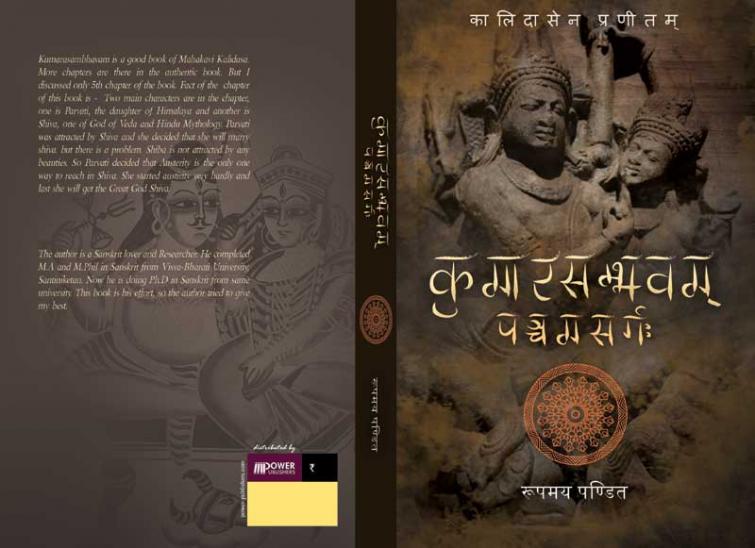
Book review: A book to help you understand poet Kalidasa's epic poem Kumarsamvabam
Drawn by the underlying drama expressed in the fifth canto of the epic poem Kumarsamvabam by poet Kalidasa, Rupomay Pandit, a student of Sanskrit language, decided to embark on a general discussion on the merits of the content.
In his book, Kumarsamvabam: Pancham Sworgo, the author has given easy descriptions, meanings and annotations of the original ‘sloka’ as the book is largely intended for the students.
'Kumarsamvabam' by Kalidas is regarded as one of the finest epic poems.
It revolves around the love story of Mahadev and Parvati, whose union leads to the birth of their son, Kumara or Karthikeya.
All the eight cantos have been precisely described by Pandit but the major focus is on the fifth canto.
Each ‘sloka’ has been dealt with and the words are translated into Bengali along with a detailed description for the students as well as the literary enthusiasts.
Rupamoy Pandit’s book can be used for reference and for a better understanding.
This book will surely add to the scholastic research on Kalidasa and his writings
(Reviewed by Sayantani Sengupta)
Support Our Journalism
We cannot do without you.. your contribution supports unbiased journalism
IBNS is not driven by any ism- not wokeism, not racism, not skewed secularism, not hyper right-wing or left liberal ideals, nor by any hardline religious beliefs or hyper nationalism. We want to serve you good old objective news, as they are. We do not judge or preach. We let people decide for themselves. We only try to present factual and well-sourced news.
Support objective journalism for a small contribution.