 School Education
‘Emergency’ for global education, as fewer than half world's students cannot return to school
New York: Classes for more than 450 million students starting the new academic year are expected to be entirely remote – or for some, a mix of distance and in-person learning – the UN education and cultural organization (UNESCO) has said.
UNESCO, the lead UN agency for education globally, also highlighted persisting inequalities associated with distance learning that particularly impact vulnerable populations.
“The educational crisis remains severe,” said Audrey Azoulay, Director-General of UNESCO.
When a girl’s education is cut short, the impact on communities lasts for generations. Let’s make sure #LearningNeverStops for every girl throughout the #COVID19 crisis.
“Several generations are facing the threat of school closures, which concern hundreds of millions of students and have lasted many months. This is an emergency for global education”, she added.
This year, 900 million pre-primary to secondary students, are set to return to school between August and October. However, fewer than half – about 433 million in 155 countries – can actually return to classrooms at this stage, according to UNESCO.
Factoring in about 128 million students in the middle of their academic year, a total of 561 million students, or one-in-three pupils globally, will attend classes.
That leaves almost a billion students – two-thirds of the global student population – facing either school closures or uncertainty surrounding their classes.
Girls at a higher risk
According to UNESCO, till date, students around the world have lost an average of 60 days of schooling since lockdowns began in February and March.
Situations such as school closures, uncertainty over classes, inability to access remote learning or other challenges raises the risk of dropouts, decreased quality of learning, and negative social and economic impacts is high. Often vulnerable populations, in particular girls are at a higher risk.
It is therefore crucial that education authorities work quickly to determine how best to ensure a safe return to school, while protecting the health and safety of students and education staff, said UNESCO.
Against this backdrop, through the Global Education Coalition, UNESCO has launched the #LearningNeverStops campaign to ensure the continued learning of girls during school closures, and their safe return when schools reopen, in light of the many obstacles they face outside education, including adolescent pregnancy, early and forced marriage, and violence.
Also through the partnership, UNESCO has produced and disseminated communication and advocacy toolkits and a girls’ back to school guide to help all stakeholders.
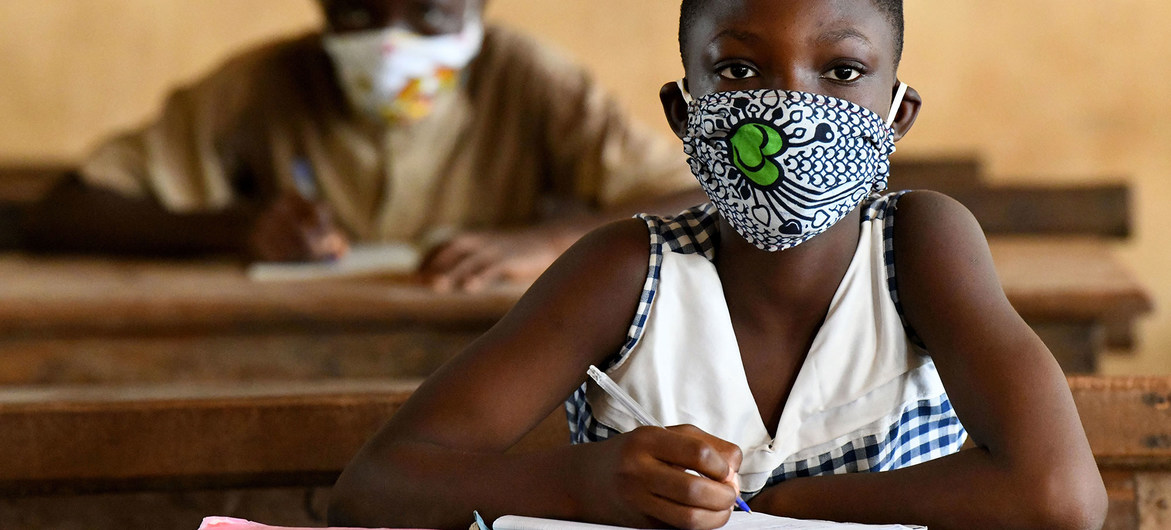
Photo caption and credit: UNICEF/Frank DejonghChildren in Côte d'Ivoire wear face masks as they return to school after temporary closures due to COVID-19.
Support Our Journalism
We cannot do without you.. your contribution supports unbiased journalism
IBNS is not driven by any ism- not wokeism, not racism, not skewed secularism, not hyper right-wing or left liberal ideals, nor by any hardline religious beliefs or hyper nationalism. We want to serve you good old objective news, as they are. We do not judge or preach. We let people decide for themselves. We only try to present factual and well-sourced news.
Support objective journalism for a small contribution.