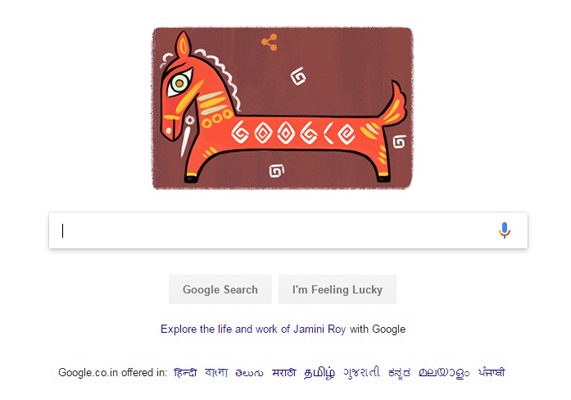
Google doodles on Jamini Roy's birth anniversary
The doodle is inspired by artist's Black Horse painting.
Roy was honoured with Padma Bhushan in 1955.
Jamini Roy was born on 11 April 1887 into a moderately prosperous family of land-owners in Beliatore village of the Bankura district, West Bengal.
When he was sixteen he was sent to study at the Government College of Art, Kolkata.
Abanindranath Tagore, the founder of Bengal school was vice principal at the institution.
He was taught to paint in the prevailing academic tradition drawing Classical nudes and painting in oils and in 1908 he received his Diploma in Fine Art.
However, he soon realised that he needed to draw inspiration, not from Western traditions, but from his own culture, and so he looked to the living folk and tribal art for inspiration.
He was most influenced by the Kalighat Pat (Kalighat painting), which was a style of art with bold sweeping brush-strokes.
He moved away from his earlier impressionist landscapes and portraits and between 1921 and 1924 began his first period of experimentation with the Santhal dance as his starting point.
Support Our Journalism
We cannot do without you.. your contribution supports unbiased journalism
IBNS is not driven by any ism- not wokeism, not racism, not skewed secularism, not hyper right-wing or left liberal ideals, nor by any hardline religious beliefs or hyper nationalism. We want to serve you good old objective news, as they are. We do not judge or preach. We let people decide for themselves. We only try to present factual and well-sourced news.
Support objective journalism for a small contribution.