 Samsung
Gurugram student develops AI-powered speech device for people with speech, voice difficulties
In a nation obsessed with ranks, cut-offs, and entrance examinations, where adolescence often feels like a relentless race toward the hallowed portals of the IITs, there occasionally emerges a young mind that dares to defy convention.
Sixteen-year-old Pranet Khetan, a Class 11 student from Shiv Nadar School, Gurugram, is one such exception, a boy who chose not to compete for marks, but to communicate for humanity.
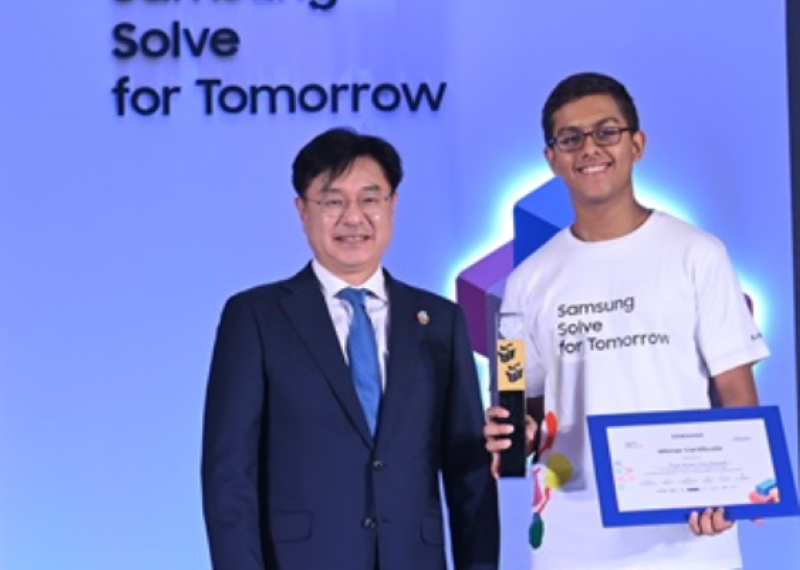
Pranet was among four winners of Samsung Solve for Tomorrow 2025, where he developed Paraspeak, a simple device that records the user’s voice, sends it to a cloud-based AI model, and plays back a translated version in clear, fluent words even in Hindi.
Samsung Solve for Tomorrow is the company’s flagship education programme that challenges young minds to identify real-world problems and develop solutions using technology.
This year the pan-India tech contest had four themes–AI for a Safer, Smarter, and Inclusive Bharat; Future of Health, Hygiene, and Well-being in India; Environmental Sustainability via Technology; and Social Change through Sport and Tech. The four winning teams received a grant of ₹1 crore incubation support at IIT Delhi.
Pranet’s immediate goal is to scale Paraspeak, refine its accuracy, and collaborate with assistive-tech firms to bring it to hospitals and homes across India. He also hopes to expand its linguistic reach, developing similar databases for other Indian languages that remain invisible to most global AI systems.
“The idea began with a simple question,” Pranet recalls. “Why is there no device that can understand impaired speech, especially when someone is struggling to articulate it?” That question, asked by a 16-year-old in the quiet hum of his school’s IT lab, would eventually lead to an invention that won him a place among the national winners of Samsung Solve for Tomorrow 2025.
The idea for Paraspeak took root in May 2024, when Pranet visited a paralysis care centre near New Delhi. There, he met patients who struggled to make themselves understood, stroke survivors, individuals with cerebral palsy, and those living with Parkinson’s disease.
Over the next year, he immersed himself in the world of automatic speech recognition (ASR) systems. When he discovered that no major database existed for dysarthric Hindi speech, the kind produced by neurological disorders, he decided to build one himself.
“This became my custom dataset,” he explains. “I trained the AI model to interpret slurred Hindi speech in real time and reconstruct it into intelligible words. The first time I heard it work, it felt as though a voice had been given back to someone who had lost it.”
At an age when most of his peers are buried under the weight of coaching books, Pranet is building bridges, not metaphorical ones, but literal pathways of sound that connect the silenced with the world around them.
His innovation, Paraspeak, is a matchbox-sized IoT-enabled device powered by artificial intelligence (AI) and machine learning (ML), designed to help patients with speech and voice disorders that emerge from conditions like stroke, paralysis, cerebral palsy, Parkinson’s disease, traumatic brain injury, or simply age-related changes. patients with speech and voice disorders that emerge from conditions like stroke, paralysis, cerebral palsy, Parkinson’s disease, traumatic brain injury, or simply age-related changes.
Armed with little more than a recorder, Pranet visited hospitals and rehabilitation centres, speaking to over twenty-eight patients and collecting hours of voice samples. Each recording, he says, was a lesson not only in data but in dignity.
Support Our Journalism
We cannot do without you.. your contribution supports unbiased journalism
IBNS is not driven by any ism- not wokeism, not racism, not skewed secularism, not hyper right-wing or left liberal ideals, nor by any hardline religious beliefs or hyper nationalism. We want to serve you good old objective news, as they are. We do not judge or preach. We let people decide for themselves. We only try to present factual and well-sourced news.
Support objective journalism for a small contribution.