India-UK joint team led by IITKGP wins Newton-Bhaba Fund Grant for groundwater arsenic research in Ganga River basin
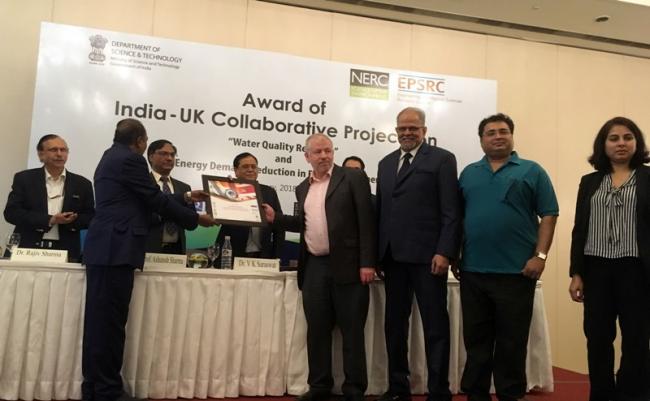
Kharagpur, Mar 13 (IBNS): IIT Kharagpuris part of the Indian team in a joint India-UK project on “Water Quality Research” that won a prestigious research grant award from the Newton-Bhabha Fund initiative.
The Fund facilitates collaboration between the research and innovation sectors of the two countries.
Beside IIT Kharagpur, the Indian team comprises of the National Institute of Hydrology (Ministry of Water Resources, RD & GR), IIT Roorkee and Mahavir Cancer Sansthan and Research Center of Patna.
The UK counterpart team will consist of the University of Manchester, British Geological Survey, University of Salford and University of Birmingham.
This particular project, entitled “Future Secular Changes & Remediation of Groundwater Arsenic in the Ganga River Basin”, is among the few that the Department of Science and Technology, Government of India, is undertaking together with the Natural Environment Research Council, United Kingdom, to jointly find solutions to the water challenges faced in the pervasively arsenic-affected Ganga River Basin.
The project, acronymed Far Ganga, will explore the vulnerability of aquifers to secular increases in arsenic in the region stretching from Uttarakhand to West Bengal, along the Indian stretch of the Ganga river.
It will try to assess how the problem of arsenic poisoning can get aggravated in the next 25 to 30 years and will try to influence groundwater management practices and water remediation technologies accordingly.
Professor Abhijit Mukherjee of IIT Kharagpur’s Department of Geology and Geophysics and School of Environmental Science and Engineering, who has worked for almost two decades in understanding natural groundwater arsenic in India and other parts of the world, is heading the project at IIT Kharagpur.
He is also instrumental in the ideation of the project.
Mukherjee says that a major gain will be some of the technology that the UK team will bring with it.
“There is immense scope for the application of new technology in this sector, such as the use of sophisticated chemical tracers and mechanistic understanding of their reactive transport as proxy of arsenic,” he says.
The added advantage is that IIT Kharagpur is already working in partnership with a part of the UK team.
“As of now, the British Geological Survey is working with IIT Kharagpur on a SandHI (IIT KGP’s Science and Heritage Initiative) project for the last three years. The Institute also has an ongoing partnership with the University of Manchester, with which it has signed a memorandum of understanding,” adds Mukherjee.
Perhaps the biggest advantage for IIT Kharagpur is the knowhow it has acquired from its previous work in assessing groundwater quality and the exploration of suitable and sustainable drinking water sources in different parts of India.
Mukherjee specializes in regional hydrogeology and groundwater contaminant transport.
He says, “We have natural laboratories for groundwater studies in Varanasi and Nadia (West Bengal), where we already have some instrumentation.” In fact, he adds, “we have several sites in different parts of India from where we have a continuous data of changes in the groundwater.”
To begin with, the project will be conducted from three sites --- the first in Bijnor, which will be mostly supervised by the National Institute of Hydrology and IIT Roorkee, the second in Varanasi and the third in Nadia.
With its sizeable work in the last two sites, Mukherjee’s team is uniquely placed to provide technical expertise.
Mukherjee says that the outcome of the project is expected to have a substantive impact on the decision-making that affects the rapid economic development and public health conditions in India, particularly in the highly populatedGanga River Basin, where the groundwater is extensively polluted with arsenic.
Support Our Journalism
We cannot do without you.. your contribution supports unbiased journalism
IBNS is not driven by any ism- not wokeism, not racism, not skewed secularism, not hyper right-wing or left liberal ideals, nor by any hardline religious beliefs or hyper nationalism. We want to serve you good old objective news, as they are. We do not judge or preach. We let people decide for themselves. We only try to present factual and well-sourced news.
Support objective journalism for a small contribution.