 Rubina
Jamia’s Rubina, PM Fellowship awardee, is a story of grit and glory
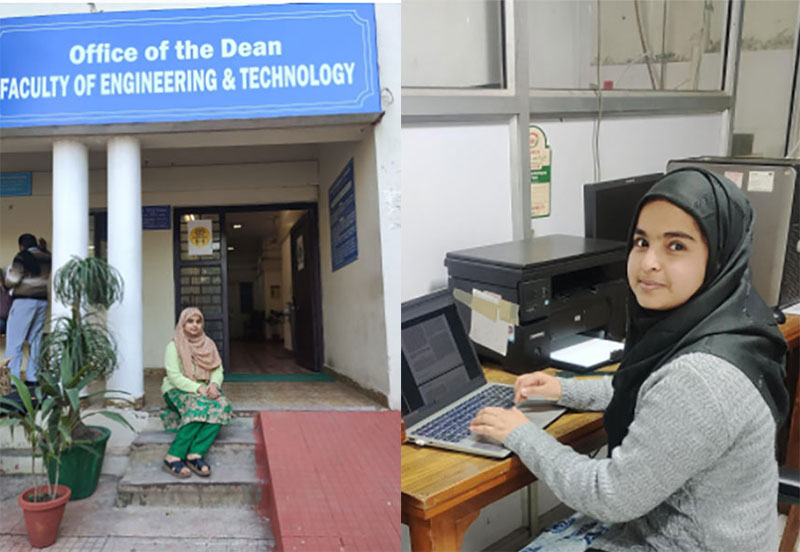
Rubina, a research scholar at Jamia Millia Islamia, selected for the coveted Prime Minister Research Fellowship under the Direct Entry category of May 2021 cycle, is a story of grit, determination and glory. Hailing from a humble family in Jamia Nagar, she has been an outstanding student throughout her academic life thus far. And, now, with PMRF assistance, she is slated to contribute innovatively in the field of Electrical Engineering, her academic discipline.
Rubina did her High School from Good Samaritan School in Jasola Vihar and then her Class 12 from Cambridge School in Sriniwaspuri. Her results in both the exams were meritorious and then she qualified for B. Tech admission in the Indira Gandhi Delhi Technical University for Women at Kashmiri Gate.
Recalling her days to attend her school and IGDTUW, Rubina says that it was quite demanding to attend her classes. “For my B. Tech classes, I had to catch two buses to reach my campus and then after going through an arduous full-day class and laboratory session, it would be very tiresome to return from the same buses back. However, the determination to pursue my dreams kept me moving,” she says.
Her determination and family’s support made her qualify for the prestigious Gate examination after her M. Tech and she got admission in PhD in Jamia Millia’s Electrical Engineering department, which has recently been in news for its innovative and recognised researches.
In Jamia, she contacted Dr Tariqul Islam, her prospective supervisor. “She was a meritorious student all through her student life. Her Gate score was satisfactory. We brainstormed to prepare a solid research proposal and recommended her name for the PMRF. The department okayed it and ultimately she was selected from several names sent for the coveted scholarship,” says Dr Tariqul Islam, Rubina’s supervisor.
Dr Islam says that the scholarship has been moulded in a way to help the research candidate quite sufficiently. “She will receive a monthly fellowship of Rs 70, 000 for first two years, Rs 75,000 for 3rd year, Rs 80,000 for the 4th year and the 5th year respectively. In addition, Rubina is also eligible for a research grant of Rs 2 lakhs per year for five years under the scheme,” says Dr Islam.
The main motivation, according to the government website, for this attractive fellowship scheme is to attract the best talent into research thereby realising the vision of development through innovation. The scheme was announced in the Budget 2018-19.
The fellowship lasts for five years.

To maintain the proper usability of the grant, the government team asks for a regular report from the concerned department in the university about the progress of the research. “We will have to send our report every six months,” says Dr Islam.
The topic of Rubina’s research is: “Design, Modelling and Fabrication of High Performance Capacitive Sensors for Non-contact Measurement of Some Important Parameters in Smart Grids.”
The capacitive sensors are extensively used for sensing applications but mostly parallel plate and planar interdigital capacitive sensors with nanostructure sensing films. Although nanostructure materials are nowadays widely used for sensing applications, the stability of the nano-materials is an important issue for real time applications.
When asked about her research and its applicability, Rubina said that right now she is doing literature survey for her research and it’ll be too early to comment on its future applicability. “However, it can be said that capacitors are used in transformers that are then used for a myriad of purposes,” says Rubina.
Dr Islam explained that the use of smart capacity sensors can be understood simply as that they will help monitoring of health of patients in hospital room online from afar by measuring the moisture, temperature, etc.
Both Rubina and Dr Islam hope that they would ensure that the application of PRF is justified and they would come up with a research that will help enhance the applicability of electrical devices.
(The writer is a Delhi-based journalist)
Support Our Journalism
We cannot do without you.. your contribution supports unbiased journalism
IBNS is not driven by any ism- not wokeism, not racism, not skewed secularism, not hyper right-wing or left liberal ideals, nor by any hardline religious beliefs or hyper nationalism. We want to serve you good old objective news, as they are. We do not judge or preach. We let people decide for themselves. We only try to present factual and well-sourced news.
Support objective journalism for a small contribution.