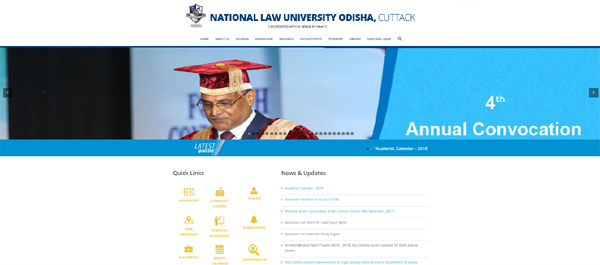
NLU Odisha offers 25% Reservation to Local Students- Apply Through CLAT
In a recent meeting, Chief Minister of Odisha approved reservation for local students in National Law University, Cuttack (also known as NLU Cuttack and NLU Odisha) which offers admission through Common Law Admission Test (CLAT). The move has been targeted to benefit local students who want to pursue law education. This decision also made the reservation criteria of the institution in line with some other NLUs.
25% Reservation for Local Students
Odisha CM, Naveen Patnaik, approved the insertion of 25% reservation for local Odisha students in the admission process of NLU Odisha. This is certainly going to be of immense benefit to local students as the institute is amongst the best law institutes across the country.
The move also came into force due to strong demand in the state regarding the reservation. Some major NLUs already proffer reservation for domicile students, primary reason why NLU Odisha had to do the same. Some of the institutes offering reservation to local students include:
â— Nalsar University of Law (Hyderabad)
â— National Law Institute University (Bhopal)
â— West Bengal University of Juridical Sciences (Kolkata)
â— Hidayatullah National Law University (Raipur)
â— Rajiv Gandhi National University of Law (Patiala)
â— Gujarat National Law University (Gandhinagar)
On the matter, Vice Chancellor of NLU Odisha, Professor Srikrishna Deva Rao said,” The proposal would have to be discussed after it is placed before the executive body of the university. If implemented, it will take effect from the next academic year, 2019-2020.”
NLU Odisha currently has 180 seats for its undergraduate courses, 120 for BA-LLB course and 60 for BBA-LLB course.
60% Marks in Class XII Needed
Apart from the basic domicile criteria that the candidate must be a resident of state Odisha to get the reservation, the state has also imposed a percentage-based criterion as well.
To be eligible for the reservation, aspirants need to have at least 60% marks in Class 12.
CLAT 2018 Dates Released
Recently, CLAT 2018 dates were announced which will be conducted by National University of Advanced Legal Studies (Kochi). CLAT 2017 was conducted by Chanakya National Law University, Patna.
CLAT 2018 registrations will begin on January 1, 2018 and will continue till March 31, 2018. The candidates can apply for the same on the official website. The test date is finalized as May 13, 2018. The results for the test can be expected in the last week of May, 2018.
CLAT 2018 will be conducted in offline mode for admission in UG and PG courses offered by various participating NLUs. The test comprises 200 Multiple Choice Questions to be completed in 2 hours, and the subjects include English, GK, Legal Aptitude, Numerical Ability and Logical Reasoning.
Earlier this year, demand for 50% reservation for local students in NLSIU Bengaluru also emerged. However, the student body of the institute strongly rejected it. Such a decision would have hampered the diversity aspect and would have been against the spirit of the university.
It can be concluded by saying that the move to grant 25% reservation to local students seems a good one to enhance the law education scenario in the state. By keeping a 60% percentage score criterion, the state is also ensuring that only deserving students get the benefit of it.
Support Our Journalism
We cannot do without you.. your contribution supports unbiased journalism
IBNS is not driven by any ism- not wokeism, not racism, not skewed secularism, not hyper right-wing or left liberal ideals, nor by any hardline religious beliefs or hyper nationalism. We want to serve you good old objective news, as they are. We do not judge or preach. We let people decide for themselves. We only try to present factual and well-sourced news.
Support objective journalism for a small contribution.