 Varanasi
Who is Giampaolo Tomassetti? Italian artist behind Varanasi painting presented to PM Modi
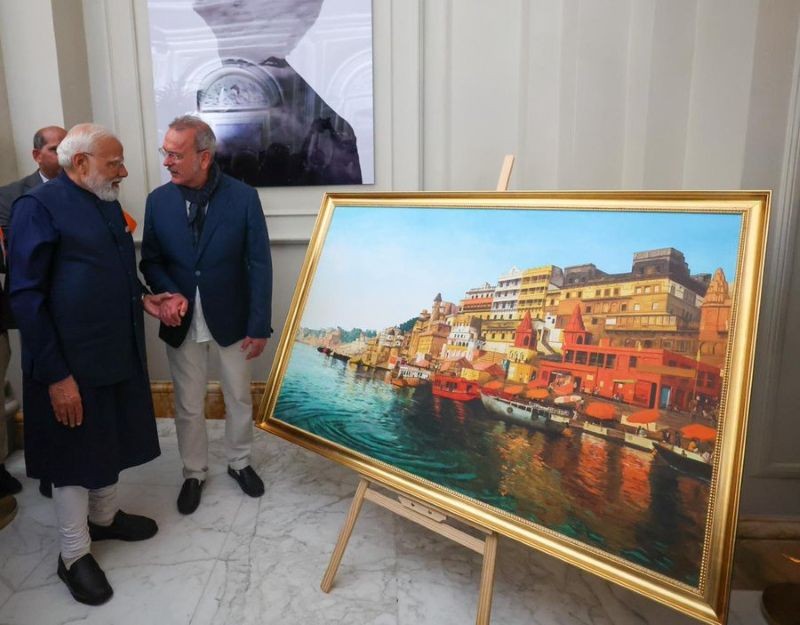
Indian Prime Minister Narendra Modi was presented with a painting depicting the ghats of Varanasi after arriving in Rome during the final leg of his five-nation tour.
The artwork was created by Italian painter Giampaolo Tomassetti, known for his long-standing engagement with Indian culture and epics. PM Modi later shared a glimpse of the painting on X, describing it as “A glimpse of Kashi in Rome!”
A glimpse of Kashi in Rome!
— Narendra Modi (@narendramodi) May 20, 2026
Mr. Giampaolo Tomassetti, an Italian painter, presented his work on Varanasi. His passion for Indian culture goes back over four decades. In the 1980’s he started as an illustrator for books on Vedic culture. From 2008 to 2013 he worked on 23 large… pic.twitter.com/tYfLPb8ubC
He added that Tomassetti’s association with Indian traditions spans over four decades. According to the Prime Minister, the artist began his journey in the 1980s as an illustrator of books on Vedic culture and later dedicated years to large-scale works inspired by the Mahabharata, producing 23 major paintings between 2008 and 2013.
Who is Giampaolo Tomassetti?
Born in Italy in 1955, Giampaolo Tomassetti worked as an illustrator in Florence in the early 1980s, focusing on publications related to ancient Vedic traditions. His early work was influenced by neo-Renaissance techniques, which played a key role in shaping his artistic evolution.
As per his official website, in 1987, he moved to Città di Castello, the birthplace of the renowned artist Alberto Burri. The cultural environment of the town, along with his artistic interactions there, helped him develop a distinctive metaphysical figurative style.
Between 2008 and 2013, Tomassetti undertook an ambitious Mahabharata project, creating 23 large paintings inspired by the Indian epic, further strengthening his artistic connection with Indian philosophy and mythology.
Speaking about his meeting with PM Modi, Tomassetti told ANI that the experience was “fantastic” and “one of the best moments” of his life.
He added that the Prime Minister was warm and curious, even asking how long the painting took to complete. For the artist, the work symbolized “a bridge between the eyes of an Italian artist and the colourful culture of India.”
Modi in Italy
PM Modi arrived in Rome as part of the final leg of his international tour and was warmly received by Italian Prime Minister Giorgia Meloni. She welcomed him with a post on X featuring a selfie of the two leaders against the illuminated backdrop of the Colosseum, calling him “my friend.”
Upon landing in Rome, had the opportunity to meet Prime Minister Meloni over dinner followed by a visit to the iconic Colosseum. We exchanged perspectives on a wide range of subjects. Looking forward to our talks today, where we will continue the conversation on how to boost the… pic.twitter.com/df0bDYKCdU
— Narendra Modi (@narendramodi) May 20, 2026
The post quickly gained traction, drawing widespread engagement online.
Later, PM Modi shared images from the meeting and dinner with PM Meloni, noting discussions on strengthening India–Italy relations. He also highlighted their visit to the Colosseum and expressed optimism about continued cooperation between the two nations.
Support Our Journalism
We cannot do without you.. your contribution supports unbiased journalism
IBNS is not driven by any ism- not wokeism, not racism, not skewed secularism, not hyper right-wing or left liberal ideals, nor by any hardline religious beliefs or hyper nationalism. We want to serve you good old objective news, as they are. We do not judge or preach. We let people decide for themselves. We only try to present factual and well-sourced news.
Support objective journalism for a small contribution.