America wants bigger Indian influence in East and South East: US Consul General
Speaking at the Building Pan Asian Connectivity Conference here recently, U.S Consulate General Craig Hall said, “The United States government has said publicly and formally that they have a strategic interest in seeing regional connectivity starting from this part of India increase and extend”.
Some of these interests include a vision to seeing India’s influence increase in the region, he said.
Hall also mentioned the importance of North-East India, saying that much of the north east today is not stable.
"We say that it's a little problem here and there, but there's a large slice of North East India that I couldn't go to if I wanted to, and neither could potential investors and businessmen, thereby increasing the disparity between the region and the rest of the country," he said.
“Economic growth for the nation, region and the global community is also vital to this (strategic) interest for with increased prosperity comes an increase in stability and we shouldn’t take stability in the region for granted," said Hall.
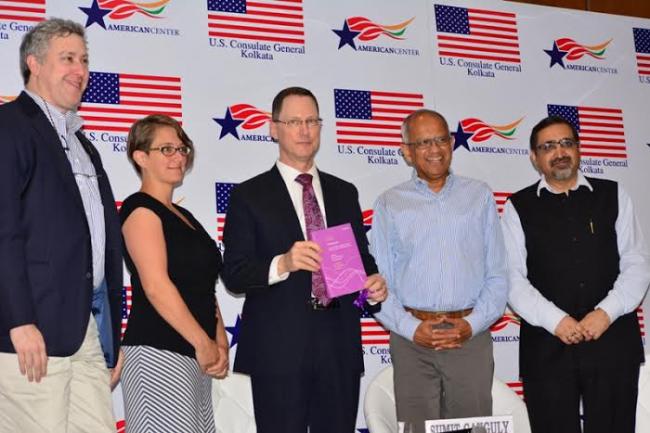
In a significant follow up to the same conference last year, the U.S Consulate General-Kolkata, the Center on American and Global Security at Indiana University (CAGS), and the Observer Research Foundation (ORF) launched a report ‘Heading East: Security, Trade, and Environment between India and Southeast Asia”.
The report was published by the Oxford University Press and launched by U.S Consul General Craig Hall, Dr. Sumit Ganguly, Rabindranath Tagore Chair in Indian Cultures and Civilizations and Director of the CAGS at Indiana University, Bloomington along with Dr. Karen Stoll Farrell, Head of the Area Studies Department at Indiana University Libraries, Bloomington.
In a short session that preceded the launch of the book, the panellists touched upon some crucial points, especially in this contemporary world; regarding the nation’s ‘Look East’ policy and the U.S’ rebalance to Asia and the significance of regional connectivity.
Speaking on the U.S’ Asia re balance policy, Hall said, “None others can take the post world war II era of historically unparalleled peace and prosperity in the Asia Pacific region for granted. It requires maintenance and nurturing, and is not inevitable.”
The United State’s future prosperity and security is inextricably tied to the Asia Pacific region, he said. Nowhere in the world are U.S economic and strategic opportunities clear or more compelling than in the Asia Pacific region, he added.
“It’s home to four of our top ten trading partners, five of seven of our bilateral treaty alliances and the world’s largest and fastest growing economies including 40% of overall global growth in nearly two thirds of the global middle class and some of the most innovative people in the world," said Hall.
Hall also touched upon some of the efforts that involved in this rebalance.
"Some of these are bolstering our treaty allies, deepening engagement with emerging powers, strengthening regional institutions, promoting trade and investment, enhancing the U.S military posture, advancing democratic reforms and creating new networks of trilateral and multilateral relationships," he said.
Hall also elaborated on the importance of the dynamics of relationships with various countries, from China to Burma (Myanmar) and even stressed on the strategic location of India in the Asia Pacific region, both geographically and economically.
Speaking on the book, Professor Ganguly commented that the report contains detailed and crucial matters related to trade, connectivity and security issues of India’s north east and South East Asia and also India’s ‘Look East’ policy.
The book was launched by academicians along with Ashok Dhar of Oxford University Press.
(Reporting by Tanushree Sen)
Support Our Journalism
We cannot do without you.. your contribution supports unbiased journalism
IBNS is not driven by any ism- not wokeism, not racism, not skewed secularism, not hyper right-wing or left liberal ideals, nor by any hardline religious beliefs or hyper nationalism. We want to serve you good old objective news, as they are. We do not judge or preach. We let people decide for themselves. We only try to present factual and well-sourced news.
Support objective journalism for a small contribution.