 Jaishankar
‘Bad neighbours’: Jaishankar shreds Pakistan, defends India’s right to act against cross-border terror
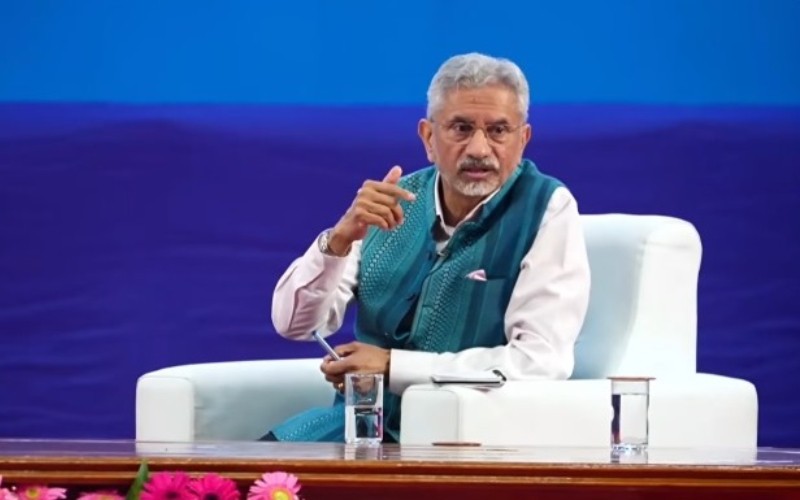
Chennai/IBNS: External Affairs Minister S Jaishankar on Friday delivered a sharp message on India’s security posture, describing Pakistan as a “bad neighbour” and asserting New Delhi’s unquestionable right to protect its citizens from terrorism.
Addressing students at the Indian Institute of Technology (IIT) Madras, Jaishankar said that India will decide for itself how and when to act against threats to its national security, underlining that “nobody can tell us what we should or should not do.”
His remarks were widely seen as a reference to India’s counter-terror operation, Operation Sindoor.
My interaction with students at @iitmadras #Chennai
— Dr. S. Jaishankar (@DrSJaishankar) January 2, 2026
https://t.co/9DcdQqJtf9
India exercised its right to self-defence last year by targeting terror infrastructure in Pakistan and Pakistan-occupied Kashmir (PoK) following the deadly Pahalgam terror attack in Jammu and Kashmir in April.
The attack, which killed 26 civilians, was carried out by The Resistance Front, a known proxy of the Pakistan-based Lashkar-e-Taiba (LeT).
“You can also have bad neighbours. Unfortunately, we do,” Jaishankar said, referring to Pakistan’s western border.
He added that if a country “deliberately, persistently and unrepentantly” uses terrorism as a tool of state policy, India is fully justified in responding to protect its people.
The external affairs minister stressed that the manner in which India defends itself is a sovereign decision.
“How we exercise that right is up to us. We will do whatever we have to do to defend ourselves,” he said.
Jaishankar also spoke about the Indus Waters Treaty (IWT) of 1960, which was suspended following the Pahalgam attack.
He argued that agreements based on good neighbourly conduct cannot continue if one side consistently undermines peace.
“If there is no good neighbourliness, you don’t get the benefits of that good neighbourliness. You can’t demand cooperation while continuing terrorism,” he remarked.
Contrasting Pakistan with India’s broader regional approach, Jaishankar said the country is surrounded by neighbours of many kinds.
He noted that when neighbours are constructive or at least not hostile, India’s natural instinct has been to extend support and cooperation.
Last month, Jaishankar had also stated that many of India’s long-standing security challenges originate from the Pakistani military establishment, remarks that were seen as a veiled reference to Pakistan Army Chief Field Marshal Asim Munir.
Tensions between India and Pakistan escalated sharply after the April 22 Pahalgam attack.
In response, India launched Operation Sindoor on May 7, striking multiple terror camps across the border and in PoK, eliminating over 100 terrorists.
Pakistan retaliated with missile and drone attacks, which were successfully intercepted by Indian defence systems.
Indian armed forces later targeted Pakistani airfields, following which a ceasefire was announced on May 10.
Support Our Journalism
We cannot do without you.. your contribution supports unbiased journalism
IBNS is not driven by any ism- not wokeism, not racism, not skewed secularism, not hyper right-wing or left liberal ideals, nor by any hardline religious beliefs or hyper nationalism. We want to serve you good old objective news, as they are. We do not judge or preach. We let people decide for themselves. We only try to present factual and well-sourced news.
Support objective journalism for a small contribution.