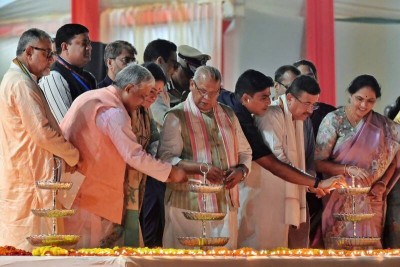
Book on Gujarat's tribal people released
The co-authors take the readers through their experiences of seeing, meeting and talking to tribal people of Gujarat.
The authors identify the positive changes and improvement in the lives of the Scheduled Tribes (STs) and study the reasons behind them.
Moreover, the book elaborates on the initiatives and schemes of the state government for the tribal population and explains in details how a different approach to implementation of such schemes helped immensely.
According to official data, Gujarat accounts for about 8.9 percent of total tribal population in India, only after Madhya Pradesh (14.5 %), Maharashtra (10.2 %) and Odisha (9.7 %).
According to the 2011 Census, Gujarat’s tribal population is 8.92 million, which is spread across 12 districts.
In some sections, the authors have adopted an anecdotal style of writing to bring alive tribal stories lucidly.
Another distinct feature is that certain sections of the book are in the words of the tribal people themselves.
In the concluding chapter, the authors evaluated the sustainability of Gujarat government’s tribal initiatives and approaches to implementation, which break away from the traditional approaches to tribal poverty.
They examined critically if it was easier for Gujarat to achieve tribal development, only to find that Gujarat government also had its share of tall challenges – overcome through non-conventional approach to tribal issues.
Finally, the authors discussed the possibilities of replicating in other states, what they call, ‘The Gujarat Model’ for tribal development.
Support Our Journalism
We cannot do without you.. your contribution supports unbiased journalism
IBNS is not driven by any ism- not wokeism, not racism, not skewed secularism, not hyper right-wing or left liberal ideals, nor by any hardline religious beliefs or hyper nationalism. We want to serve you good old objective news, as they are. We do not judge or preach. We let people decide for themselves. We only try to present factual and well-sourced news.
Support objective journalism for a small contribution.