 Bangladesh
Borderline power shift: Why Jamaat’s frontier wins in Bangladesh are ringing alarm bells in New Delhi
The spotlight after Bangladesh’s general election did not rest solely on the sweeping national victory of the Bangladesh Nationalist Party (BNP) led by Tarique Rahman.
Instead, what drew sharper attention in policy and security circles was the strong showing by hardline Jamaat-e-Islami in constituencies hugging the India-Bangladesh border, a development that has prompted renewed scrutiny in New Delhi.
While the BNP secured a comfortable national mandate, Jamaat recorded its highest parliamentary tally in over two decades, with a concentration of wins in frontier districts facing India.
For Indian strategists, the geography of these victories matters as much as the numbers.
Why border constituencies matter more than seat counts
India and Bangladesh share a long and complex boundary marked by rivers, enclaves, densely populated villages and informal crossings.
Control and influence in these districts shape how effectively law enforcement, intelligence cooperation and local administration function on the ground.
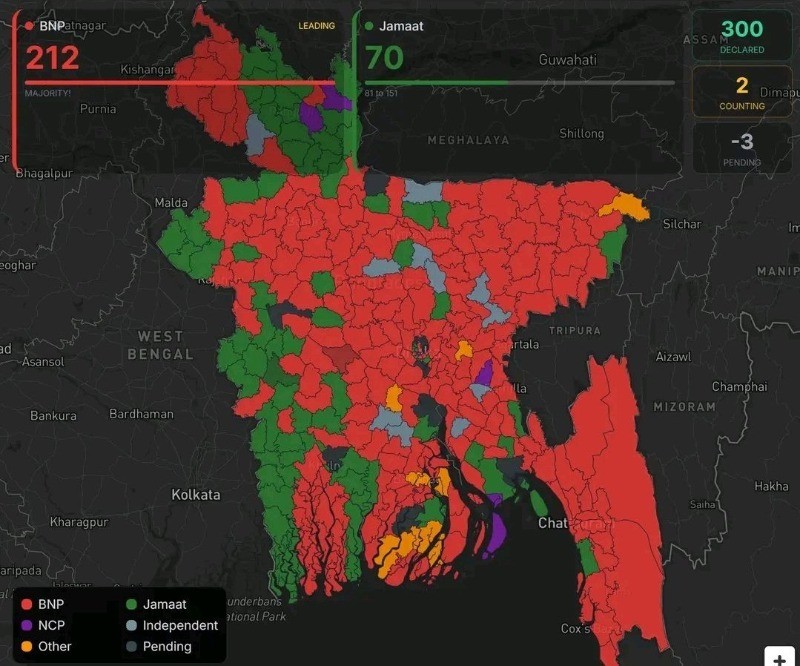
Jamaat’s consolidation in border-facing seats alters the local political ecosystem.
Even without holding national power, representation in these constituencies can influence district-level governance, policing priorities and the social climate in areas that have historically been sensitive to smuggling, illegal migration and extremist movement.
Ideological backdrop that worries India
Jamaat-e-Islami’s political legacy carries particular resonance in India’s security discourse.
During Bangladesh’s 1971 Liberation War, the Jamaat opposed independence and aligned with Pakistan’s military establishment, a history that continues to inform perceptions in Indian policy circles.
Although there is no contemporary judicial finding establishing Jamaat as a proxy for Pakistan’s security agencies, its ideological orientation and past positions distinguish it sharply from mainstream secular parties.
Indian analysts argue that this background, when combined with control over border constituencies, creates conditions that merit closer monitoring rather than immediate alarm.
From national politics to local ecosystems
Assessments cited by Indian agencies suggest Jamaat’s support in frontier regions is rooted less in urban protest voting and more in rural networks centred on mosques and madrassas.
These networks, officials say, have deep social reach and historical memory, allowing influence to accumulate gradually rather than through sudden mobilisation.
Such dynamics matter because border management is often shaped locally.
Even when national governments commit to cooperation, everyday enforcement depends on district administrations, police stations and informal community power structures.
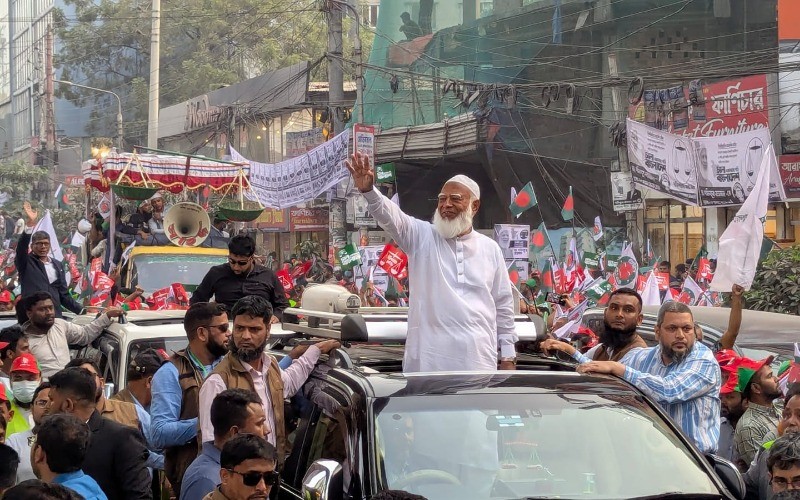 Jamaat-e-Islami chief Shafiqur Rahman. Photo: Facebook/@BJI.Official
Minority anxieties and migration sensitivities
Another dimension drawing attention in India is the potential impact on religious minorities in Bangladesh’s border districts.
Security assessments warn that as Jamaat’s influence grows locally, Hindu minorities may face pressures ranging from land disputes to intimidation and quiet displacement.
For India, even small migration flows triggered by such pressures can have outsized political and social consequences in border states like West Bengal, where cross-border kinship ties already exist, and demographic shifts are politically sensitive.
A shift from mass infiltration to selective movement
Indian intelligence officials do not publicly suggest an imminent security threat or direct militant activity linked to Jamaat’s electoral gains. Instead, they describe a subtler risk profile.
The concern, according to these assessments, is moving away from large-scale illegal migration toward selective infiltration involving ideologically motivated individuals, fund couriers or digital handlers.
Such movements, fewer in number and harder to detect, are viewed as potentially higher impact over time, especially if local environments become more permissive due to political cover or administrative hesitation.
The Pakistan factor: suspicion without verdict
Allegations of links between hardline Bangladeshi Islamist networks and Pakistan’s Inter-Services Intelligence have surfaced periodically in Indian discourse.
While Jamaat’s historical alignment with Pakistan is documented, contemporary claims remain largely within the realm of intelligence assessment rather than court-established fact.
Notably, Bangladesh’s interim authorities lifted a long-standing ban on Jamaat in 2024, stating there was insufficient evidence at that time to justify proscription on terrorism grounds.
This decision has added another layer of complexity to how India interprets Jamaat’s political resurgence.
Changing Dhaka–Delhi equation
The broader diplomatic context also shapes India’s reading of the results.
Relations between India and Bangladesh have been more uncertain since the ouster of former prime minister Sheikh Hasina and her subsequent move to India.
While the BNP leadership has signalled an intention to keep ties with India functional, it has also spoken of recalibrating the relationship on what it describes as a more balanced footing.
For New Delhi, the key question is whether the close security cooperation seen during the Hasina years will remain consistent across Bangladesh, particularly in border districts now represented by Jamaat lawmakers.
A development to watch, not a verdict to deliver
Jamaat’s success in Bangladesh’s frontier seats does not automatically translate into instability or confrontation.
However, it reshapes local power equations along one of South Asia’s most sensitive borders.
For India, the significance lies less in immediate threats and more in how ideology, administration and geography intersect over time.
Support Our Journalism
We cannot do without you.. your contribution supports unbiased journalism
IBNS is not driven by any ism- not wokeism, not racism, not skewed secularism, not hyper right-wing or left liberal ideals, nor by any hardline religious beliefs or hyper nationalism. We want to serve you good old objective news, as they are. We do not judge or preach. We let people decide for themselves. We only try to present factual and well-sourced news.
Support objective journalism for a small contribution.