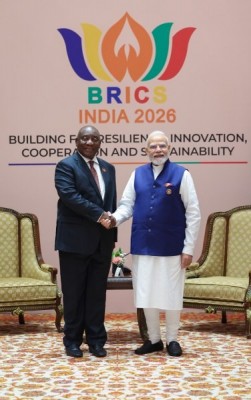
Narendra Modi
Cabinet approves Ratification of seven Persistent Organic Pollutants listed under Stockholm Convention
New Delhi: The Union Cabinet, chaired by Prime Minister Narendra Modi has approved the Ratification of seven (7) chemicals listed under Stockholm Convention on Persistent Organic Pollutants (POPs).
The Cabinet further delegated its powers to ratify chemicals under the Stockholm Convention to Union Ministers of External Affairs (MEA) and Environment, Forest and Climate Change (MEFCC) in respect of POPs already regulated under the domestic regulations thereby streamlining the procedure.
The Stockholm Convention is a global treaty to protect human health and environment from POPs, which are identified chemical substances that persist in the environment, bio-accumulate in living organisms, adversely affect human health/ environment and have the property of long-range environmental transport (LRET).
Exposure to POPs can lead to cancer, damage to central & peripheral nervous systems, diseases of immune system, reproductive disorders and interference with normal infant and child development.
POPs are listed in various Annexes to the Stockholm Convention after thorough scientific research, deliberations and negotiations among member countries.
India had ratified the Stockholm Convention on January 13, 2006 as per Article 25(4), which enabled it to keep itself in a default "opt-out" position such that amendments in various Annexes of the convention cannot be enforced on it unless an instrument of ratification/ acceptance/ approval or accession is explicitly deposited with UN depositary.
Considering its commitment towards providing safe environment and addressing human health risks, the Ministry of Environment, Forest and Climate Change (MoEFCC) had notified the 'Regulation of Persistent Organic Pollutants Rules, on March 5, 2018 under the provisions of Environment (Protection) Act, 1986.
The regulation inter alia prohibited the manufacture, trade, use, import and export seven chemicals namely (i) Chlordecone, (ii) Hexabromobiphenyl, (iii) Hexabromodiphenyl ether and Heptabromodiphenylether (Commercial octa-BDE), (iv) Tetrabromodiphenyl ether and Pentabromodiphenyl ether (Commercial penta-BDE), (v) Pentachlorobenzene, (vi) Hexabromocyclododecane, and (vii) Hexachlorobutadiene, which were already listed as POPs under Stockholm Convention.
The Cabinet's approval for ratification of POPs demonstrates India's commitment to meet its international obligations with regard to protection of environment and human health.
It also indicates the resolve of the Government to take action on POPs by implementing control measures, develop and implement action plans for unintentionally produced chemicals, develop inventories of the chemicals' stockpiles and review as well as update its National Implementation Plan (NIP).
The ratification process would enable India to access Global Environment Facility (GEF) financial resources in updating the NIP.
Support Our Journalism
We cannot do without you.. your contribution supports unbiased journalism
IBNS is not driven by any ism- not wokeism, not racism, not skewed secularism, not hyper right-wing or left liberal ideals, nor by any hardline religious beliefs or hyper nationalism. We want to serve you good old objective news, as they are. We do not judge or preach. We let people decide for themselves. We only try to present factual and well-sourced news.
Support objective journalism for a small contribution.