 Indian Navy
DRDO’s deadly new missile can strike 1,500 km away — A big boost for Navy
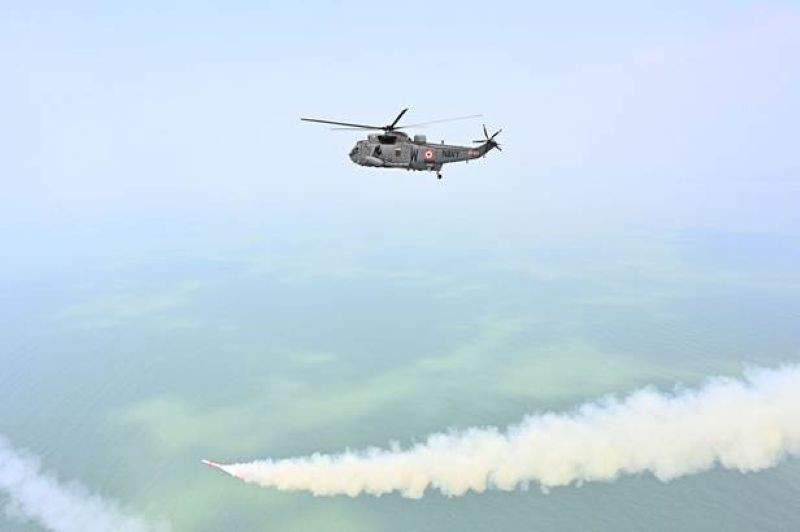
India’s Defence Research and Development Organisation (DRDO), in collaboration with the Indian Navy, has successfully carried out the maiden salvo launch of the Naval Anti-Ship Missile–Short Range (NASM-SR) from a naval helicopter platform off the coast of the Bay of Bengal near Odisha.
The milestone marks a significant advancement in India’s maritime defence capabilities.
During the trial, two missiles were launched in quick succession from the same helicopter, marking the first-ever salvo launch of an advanced air-launched anti-ship missile system by India.
The @DRDO_India & Indian Navy successfully jointly conducted the maiden Salvo launch of Naval Anti-ship Missile-Short Range (NASM-SR) from Indian Navy’s helicopter platform, off the coast of Bay of Bengal in Odisha.
— रक्षा मंत्री कार्यालय/ RMO India (@DefenceMinIndia) April 29, 2026
Raksha Mantri Shri @rajnathsingh complimented DRDO, Indian… pic.twitter.com/oPmiyAOZlG
According to reports, the missile boasts a strike range of over 1,500 km, substantially extending India’s operational reach into deep ocean territories. With a reported speed of Mach 10, it stands among the fastest in its class.
“All test objectives were fully met,” a government statement said, noting that performance data was captured using advanced tracking systems, including radar, electro-optical sensors, and telemetry deployed by the Integrated Test Range (ITR) in Chandipur.
In addition to validating salvo launch capability, the trials also demonstrated precise waterline hit capability—critical for disabling enemy vessels. The tests were witnessed by senior DRDO scientists, representatives from the Indian Air Force, and officials from development-cum-production partners.
The NASM-SR missile features a solid propulsion booster paired with a long-burn sustainer. It integrates advanced indigenous technologies, including a state-of-the-art seeker, fibre-optic gyroscope-based inertial navigation system, radio altimeter, high-bandwidth two-way data link, and sophisticated control and guidance algorithms.
The system has been developed by Research Centre Imarat in Hyderabad, in collaboration with other DRDO laboratories such as Defence Research and Development Laboratory, High Energy Materials Research Laboratory, and Terminal Ballistics Research Laboratory, along with ITR Chandipur.
Defence Minister Rajnath Singh congratulated DRDO, the armed forces, and industry partners for the successful test, stating that the development would significantly enhance the operational capabilities of India’s defence forces.
Dr. Samir V Kamat, Secretary of the Department of Defence R&D and Chairman of DRDO, also commended the teams involved for the successful execution of the salvo launch.
Support Our Journalism
We cannot do without you.. your contribution supports unbiased journalism
IBNS is not driven by any ism- not wokeism, not racism, not skewed secularism, not hyper right-wing or left liberal ideals, nor by any hardline religious beliefs or hyper nationalism. We want to serve you good old objective news, as they are. We do not judge or preach. We let people decide for themselves. We only try to present factual and well-sourced news.
Support objective journalism for a small contribution.